

For a area as consumed by its politicians, film stars, and cricketers as South Asia, change is seldom fixed. However at any time when the winds of revolution have blown throughout the meadows of the Indian Subcontinent, change has been precipitous and regime-toppling.
The upcoming Asia Cup will witness an identical shift, albeit of a cricketing selection, when India, Pakistan, and Bangladesh lock horns in an eight-team continental showdown, starting on Tuesday within the impartial territory of the United Arab Emirates (UAE).
As disjointed from one another as they might be within the geopolitical panorama, the three neighbouring nations discover resonance within the compulsive deification of cricketing personalities. The aura of their star cricketers, accentuated by social media fandom, has change into synonymous with the identities of their groups. Sri Lanka, in perpetual transition since its 2014 T20 World Cup triumph, is the outlier.
Such an inextricable affiliation between a participant and a group is probably inevitable on condition that India hasn’t performed a big-ticket match in white-ball cricket with out both Rohit Sharma or Virat Kohli since 2010. Or that Pakistan’s final tryst with a limited-over multilateral competitors sans Babar Azam and Mohammad Rizwan dates to 2016, when Shahid Afridi was main the facet. Bangladesh, in the meantime, is but to function in a T20 World Cup or Asia Cup match with out a minimum of one in all Shakib Al Hasan, Mushfiqur Rahim, and Mahmudullah.
This ensemble forged formed the future of their groups for a decade or extra, and in what seems to be a tectonic shift, a bunch of technique actors have stepped into their breach.
With choice veering in direction of pragmatism and role-specific affect within the period of power-hitting, the subsequent cricketing decade in Asia may mitigate the prevalence of ‘star tradition’ as we all know it.
Methodology performing is a refined artwork that requires its practitioners to remain in character and innately establish with their roles. On the cricket discipline, that interprets to at least one’s job profile being attuned to the group’s calls for, with self-indulgence taking a backseat.
India, Pakistan and Bangladesh’s newfound T20 adventurism is sure by the frequent thread of an more and more horses-for-courses choice coverage, however the circumstances that prompted the pivot differ.
Pure development
Rohit and Kohli retired with the T20 World Cup medal round their neck final yr. However solely after they had been apprised of India’s shift in direction of a better tempo of T20 batting throughout their 14-month hiatus from the format forward of the worldwide showpiece.
After two disappointing T20 World Cup campaigns, in 2021 and 2022, India’s batting strategy was in dire want of recent intent, and blooding in new expertise was deemed the treatment. A renewed emphasis on maximising the PowerPlay reaped dividends, with the group racking up seven scores of 200 or extra in 21 accomplished innings. In Rohit and Kohli’s absence, India’s PowerPlay run price swelled to eight.31, up from a dismal 6.02 through the T20 World Cup in 2022 and seven.87 in 2021.
Away from the worldwide stage, Rohit and Kohli cranked up their tempo throughout IPL 2023, considerably bettering their strike charges from the earlier season. In 2024, they reached a crescendo, logging their highest strike charges for a season, 150 and 154.69, respectively, and justifying their return for the T20 World Cup.
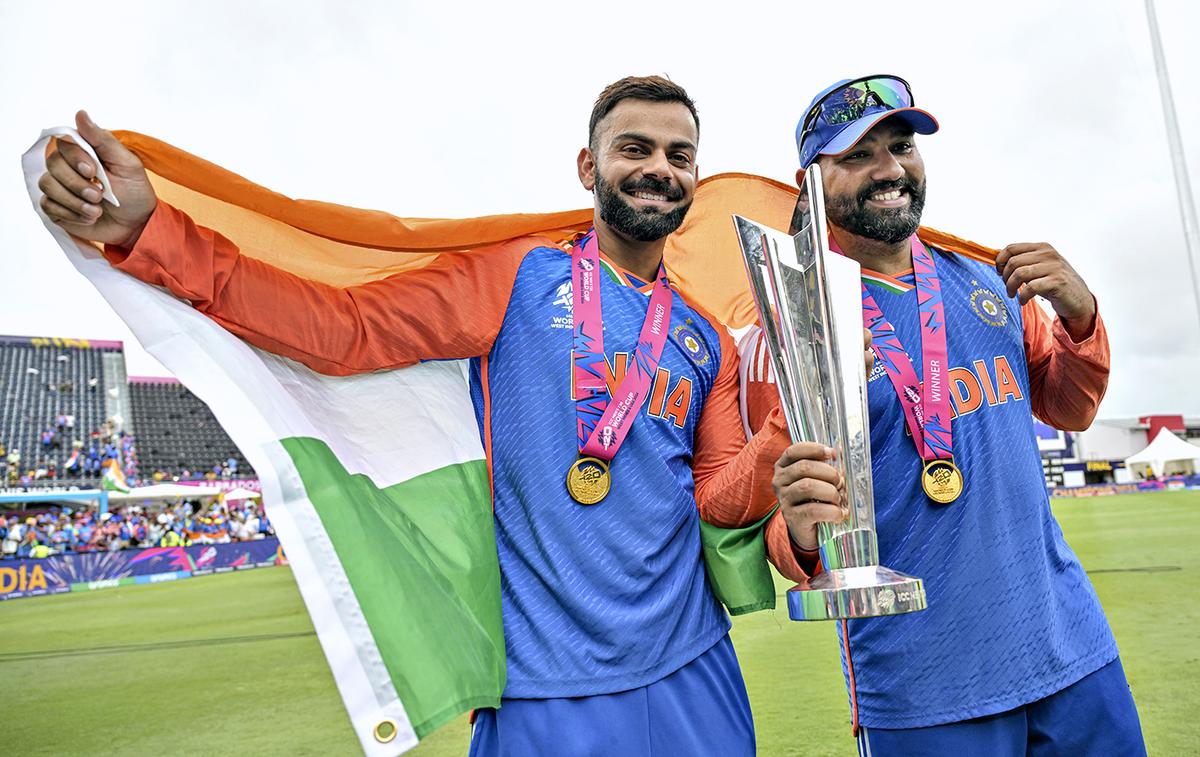
Virat Kohli (left) and Rohit Sharma have fun with the T20 World Cup 2024 trophy after defeating South Africa within the last.
| Photograph Credit score:
DEEPAK KR

Virat Kohli (left) and Rohit Sharma have fun with the T20 World Cup 2024 trophy after defeating South Africa within the last.
| Photograph Credit score:
DEEPAK KR
The title win was an ideal swansong, however that even within the twilight of their profession, they needed to embrace modernity or danger shedding relevance was a testomony to India’s tilt in direction of a team-centric paradigm. Of their wake, the Indian group’s transition has been seamless, due to a structured integration that started proper after India’s unceremonious semifinal exit from the T20 World Cup in 2022.
Barring skipper Suryakumar Yadav, all-rounder Hardik Pandya, and Arshdeep Singh, there have been few constants in India’s T20I group since. Useful resource optimisation is the order of the day, and job profiles outweigh consistency and pedigree. For the present framework, the omissions of Shreyas Iyer and Yashasvi Jaiswal from the squad are unavoidable sacrifices on the altar of the effectivity of a well-oiled machine.
ALSO READ | India mulls over bowling mixture in run as much as title defence in UAE
Shubman Gill’s return to the T20I fold, maybe at the price of Sanju Samson’s place within the eleven, seems as a relic of ‘star tradition’, nevertheless it comes with the rider of grooming a future all-format captain.
Rohit and Kohli’s ‘star participant’ standing largely stems from their proficiency in all codecs, an epithet that would elude the likes of Abhishek Sharma, Tilak Varma, Shivam Dube, or Rinku Singh. Jasprit Bumrah dominates all shapes and types of the sport, however his intermittent absences may stop him from attaining a equally exalted standing.
As issues stand, the present Indian T20I set-up bears the imprint of a chillingly environment friendly and profitable franchise group that thinks little of the previous and has recognized the personnel attuned to the fearless model of cricket it has dedicated to.
Getting in circles
If some put together for change, some have change thrust upon them. Pakistan belongs to the latter class. Babar and Rizwan scripted arguably essentially the most epochal second for Pakistan cricket on this decade by handing India a 10-wicket defeat in Dubai on the T20 World Cup 2021 however have caught a tartar since.
Pakistan, admittedly, reached the ultimate of the World Cup the next yr, however that was largely to the credit score of its bowlers. The batters struck a lowly 7.91 runs an over in 2022 – the seventh lowest among the many 12 ICC Full Members. The rut continued in 2023 and 2024, with the common run of scoring at 8.08 and eight.22, seventh and fifth lowest, respectively, among the many similar band of groups.
An unedifying group-stage exit on the T20 World Cup in 2024, which included a defeat to the united statesA. within the Tremendous Over, ought to have sounded alarm bells. Pakistan had hit a roadblock and so had Babar and Rizwan’s adaptability. Babar struck at 136.8 and Rizwan at a lowly 98.05 over successive sequence defeats in Australia and South Africa in direction of the top of that yr. After 23 defeats in 38 T20Is throughout 2023 and 2024, Pakistan needed to chew the bullet.
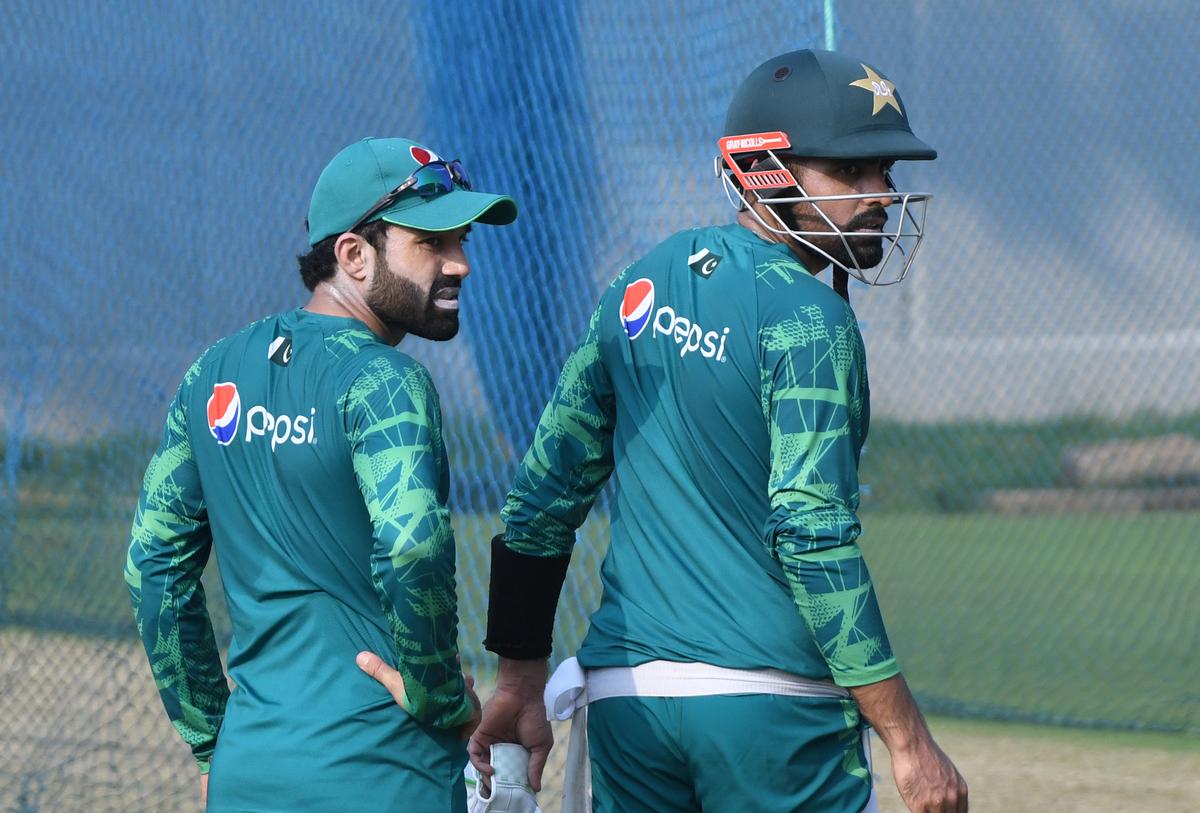
Pakistan’s Babar Azam and Mohammad Rizwan throughout a apply session forward of the ICC Males’s Cricket World Cup 2023 match between Afghanistan and Pakistan.
| Photograph Credit score:
JOTHI RAMALINGAM B
Pakistan’s Babar Azam and Mohammad Rizwan throughout a apply session forward of the ICC Males’s Cricket World Cup 2023 match between Afghanistan and Pakistan.
| Photograph Credit score:
JOTHI RAMALINGAM B
Its experiment with ultra-modernism started with a five-match T20I tour of New Zealand within the first half of this yr. Babar and Rizwan had been dropped and changed on the high of the batting order by debutant Hasan Nawaz and Mohammad Haris, again within the nationwide facet after nearly two years.
That they had scored runs at a modest common within the newly minted Champions T20 Cup, however their six-hitting potential stood out. Nawaz had 17 sixes in 9 matches (second-most), whereas Haris was cranking it at nearly 152 per 100 balls through the match.
Their choice was homage to the ‘increase or bust’ T20 college of thought, as had been their subsequent scores. Nawaz’s initiation included two consecutive geese, whereas Haris scored all of 11 runs within the first two video games towards the Kiwis. However they bought the bit between their tooth within the third, ransacking 74 runs contained in the Powerplay; Nawaz scored the quickest hundred by a Pakistani within the format, and his 55-ball 105 munched a 205-run goal with 4 overs to spare. The brand new opening pair failed within the two video games that adopted, however their introduction had laid down an essential marker—revolutions don’t all the time begin with pragmatism.
The white-ball tour of New Zealand additionally marked the start of Salman Ali Agha’s reign as full-time T20I captain. He was first handed the reins when he was all of two T20Is outdated, and was appointed full-time skipper in simply his seventh worldwide sport within the format, bringing an finish to the musical chairs between Babar, Rizwan and Shaheen Afridi for the management position.
Within the sequence towards Bangladesh at residence that adopted in Could, the primary below head coach Mike Hesson, Pakistan maybe thought Nawaz and Haris’ spin-hitting prowess was higher employed within the middle-order, and despatched Sahibzada Farhan up the order with Saim Ayub, who had been earmarked as somebody who may disrupt the Babar-Rizwan pairing.
Farhan was picked within the immediacy of the lately concluded Pakistan Tremendous League (PSL), the place he was the highest run-getter with 449 runs at a strike price in extra of 150.
The group started shaping up and whitewashed Bangladesh 3-0 at residence earlier than the Tigers returned the favour of their den with a 2-1 win a couple of weeks later. 13 wins in 23 matches below Agha’s management recommend Pakistan’s try at a resurgence has been a blended bag, however it’s got the transient proper.
Irony, although, has been ever-present. Lower than a yr in the past, former Pakistan cricketer and PCB chief Ramiz Raja had bemoaned Babar’s axing from the Take a look at group in the course of the house sequence towards England as a result of ‘he sells cricket for Pakistan’. Simply three weeks forward of the Asia Cup, the PCB hasn’t contracted any participant within the ‘A’ class, which had appeared Babar and Rizwan’s protect.
In transition
For Bangladesh, a complete era of gamers that hauled the group up from cricketing backwaters has known as time on white-ball cricket. Rahim stays lively in Exams solely, whereas Shakib, Mahmudullah and Tamim Iqbal have drawn the curtains on internationals within the final two years.
Bangladesh has been a T20I laggard, however successive sequence wins towards Sri Lanka, Pakistan, and the Netherlands forward of the Asia Cup promise a turnaround. Its sluggish pitches at residence haven’t all the time allowed Bangladesh’s batters to discover a larger gear, however openers Parvez Hossain Emon and Tanzid Hasan are lastly setting the tone.
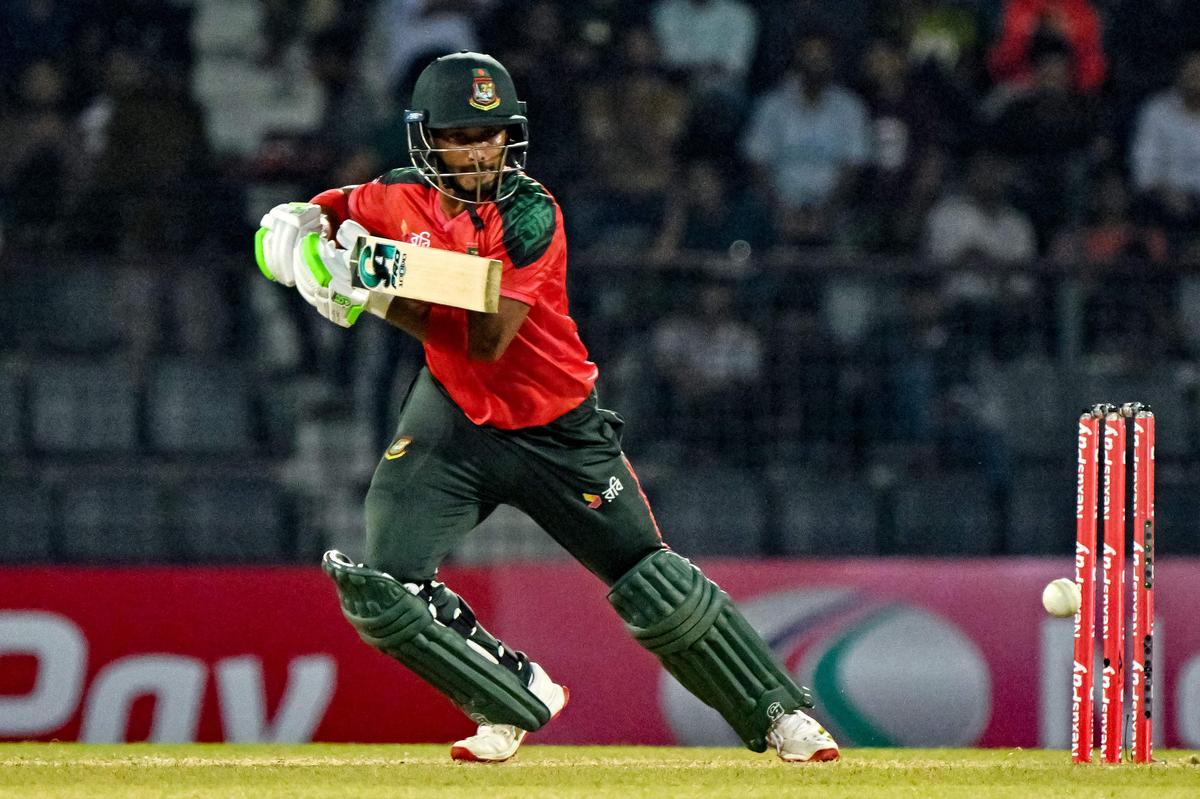
Bangladesh’s Tanzid Hasan performs a shot through the second Twenty20 worldwide cricket match between Bangladesh and the Netherlands.
| Photograph Credit score:
Mosaraf Hossain/AFP
Bangladesh’s Tanzid Hasan performs a shot through the second Twenty20 worldwide cricket match between Bangladesh and the Netherlands.
| Photograph Credit score:
Mosaraf Hossain/AFP
The opening duo, together with middle-order batter Towhid Hridoy and all-rounder Mahedi Hasan are amongst these filling the massive sneakers of Bangladesh’s all-format golden era, and none have had a shot at Take a look at cricket but.
Because the Asian cricket expertise reveals, maybe the inexorable march of time is most charitable to those that don’t resist it. Politics, film plots, and cricketing ethos have a shelf life, past which they fail to serve their goal.
The need of a subplot involving narrative arcs and a private edge on the upcoming Asia Cup may have getting used to, however a budding breed of T20 specialists thrown into the jeopardy {that a} multi-team match entails ought to preserve issues fascinating.
Revealed on Sep 09, 2025