
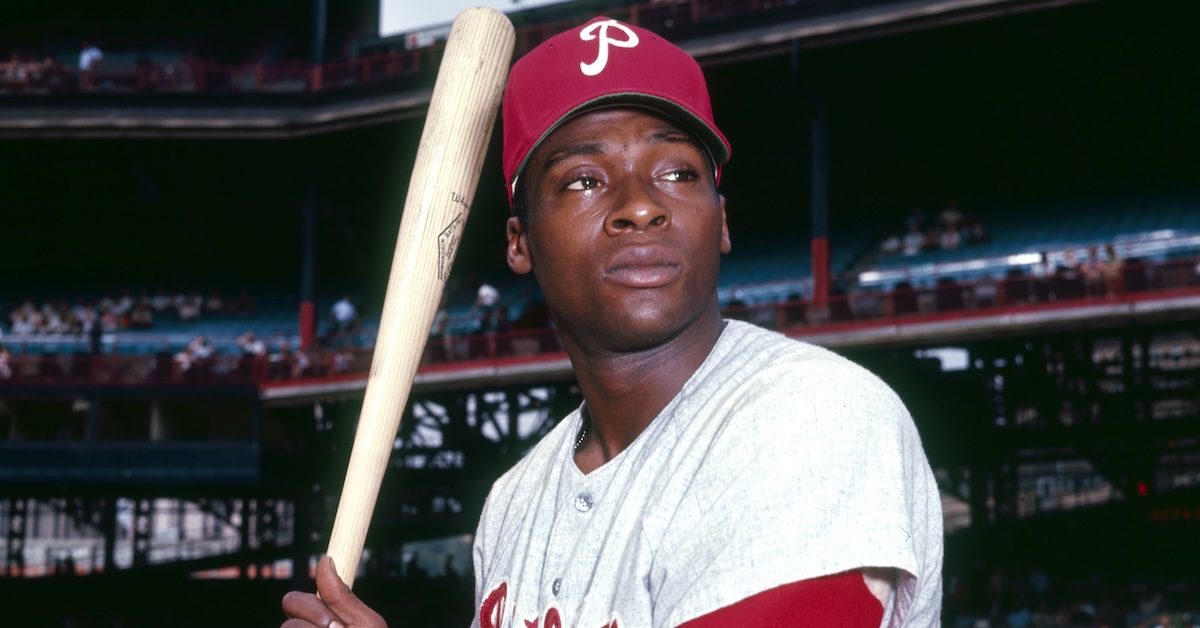

The next article is a part of a sequence in regards to the 2025 Basic Baseball Period Committee poll, masking long-retired gamers, managers, executives, and umpires whose candidacies shall be voted upon on December 8. It’s tailored from a chapter in The Cooperstown Casebook, printed in 2017 by Thomas Dunne Books. For an introduction to the poll, see right here, and for an introduction to JAWS, see right here. All WAR figures discuss with the Baseball-Reference model except in any other case indicated.
2025 Basic Baseball Candidate: Dick Allen
| Participant | Profession WAR | Peak WAR | JAWS |
|---|---|---|---|
| Dick Allen | 58.7 | 45.9 | 52.3 |
| Avg. HOF 3B | 69.4 | 43.3 | 56.3 |
| 1,848 | 351 | .292/.378/.534 | 156 |
SOURCE: Baseball-Reference
“Dick Allen compelled Philadelphia baseball and its followers to come back to phrases with the racism that existed on this metropolis within the ’60s and ’70s. He might not have completed it with the self-discipline or tact of Jackie Robinson, however he exemplified the rising independence of main league baseball gamers in addition to rising black consciousness.” — William Kashatus, The Philadelphia Inquirer, April 2, 1996
At first look, Dick Allen is likely to be seen because the Gary Sheffield or Albert Belle of his day, a heavy hitter seemingly engaged in a relentless battle with the world round him, producing controversy at each cease of his 15-year profession. It’s unfair and reductive to lump Allen in with these two gamers, nonetheless, for all of them confronted totally different obstacles and bore totally different scars from the injuries they suffered early of their careers.
In Allen’s case, these wounds predated his 1963 arrival within the majors with a group that was far behind the mixing curve, and a metropolis that was in no higher form. In Philadelphia and past, he was a polarizing presence, lined by a media contingent so unable or unwilling to narrate to him that writers usually refused to name him by the identify of his selecting: Dick Allen, not Richie.
Even whereas incomes All-Star honors seven occasions and profitable each NL Rookie of the 12 months and AL Most Beneficial Participant awards, Allen rebelled in opposition to his environment. As biographer Mitchell Nathanson wrote in God Almighty Hisself: The Life and Legacy of Dick Allen, “He refused to pander to the media, refused to just accept administration’s time-honored strategies for figuring out the worth of a ballplayer, and, most explosively, refused to go together with and kowtow to the racial double normal that had advanced inside Main League Baseball within the wake of the sport’s integration in 1947.”
Extra from Nathanson:
“[Allen] noticed plainly how rather more tough issues have been for black gamers than they have been for his or her white teammates. Expectation have been totally different, endorsement alternatives have been fewer, careers have been shorter. However issues, as he noticed them, weren’t so nice for white gamers both. Relatively than see skilled baseball as an Eden, he noticed it as a plantation. Few white gamers noticed themselves as farmhands, or, worse, chattel. Black gamers, descendants of a legacy of each, oftentimes noticed issues extra starkly.”
As Pat Corrales, Allen’s teammate in 1964-65, stated, Allen “was years forward of us [players] in seeing that it was mistaken for the house owners to have such full management over our careers.” Marvin Miller, the manager director of the Gamers Affiliation, wrote of Allen’s enter at a union assembly, “He was eloquent and forceful, and the opposite gamers listened intently. He didn’t converse as a famous person, however as a participant who understood each the problems and the significance of the gamers transferring ahead as a bunch.”
In Sports activities Illustrated in 1973, Roy Blount Jr. wrote, “Allen is the primary black man, and certainly the one up to date man of any colour, to say himself in baseball with one thing just like the unaccommodating pressure of Muhammad Ali in boxing, Kareem Abdul-Jabbar in basketball and Jim Brown in soccer.”
Allen’s conduct typically undercut his declare to occupying that lofty platform. He grew manipulative in ways in which usually bolstered unfavourable impressions whereas overshadowing his large expertise. Had he not missed a lot time because of accidents, absenteeism, and alcohol, he’d nearly actually already be within the Corridor of Fame due to gaudier counting stats. Whereas previous generations of voters wrote him off for these shortcomings, more moderen analysis has led to a higher understanding of the context for his conduct — and proven that for all the negativity that coloured the protection of him, he was revered and even beloved by many a teammate and supervisor.
Allen struggled for help throughout his 1983–97 run on the BBWAA poll, by no means reaching 20%, and he equally lagged within the voting of the expanded Veterans Committee from 2003–09. Nevertheless, thanks partly to a grassroots marketing campaign by former Phillies groundskeeper Mark Carfagno, he acquired a recent look from the 2015 Golden Period Committee and fell simply one vote brief of election. The change in Period Committee codecs meant that his case wasn’t scheduled to be reconsidered till the 2021 Golden Day Period Committee poll, however the COVID-19 pandemic led the Corridor to postpone that election. In a merciless blow, the 78-year-old Allen died of most cancers on December 7, 2020, in the future after his candidacy would have been thought of. Crueler nonetheless for his household, he once more fell one vote brief when the committee lastly met in December 2021.
The collision between baseball immortality and human mortality is a clumsy and heartbreaking one, all too frequent within the annals of the Corridor. Relating to Allen, there may be not less than some solace in the way in which he was celebrated in the course of the remaining 12 months of his life, culminating with the Phillies retiring his quantity on September 3, 2020, an try to proper previous organizational wrongs whereas proclaiming to the world — and to Allen — that they valued him. That’s not Cooperstown, but it surely’s a begin.
Richard Anthony Allen was born on March 8, 1942 in Wampum, Pennsylvania‚ a small city 30 miles northwest of Pittsburgh, the second-youngest of eight youngsters born to Period Allen, a home worker, and Coy Allen, a touring truck driver and sanitation employee who deserted the household when Dick was 15. One in every of simply 5 Black college students in Wampum Excessive Faculty’s class of 146, he starred not solely because the shortstop, however because the captain and level guard of the basketball group, the latter regardless of standing simply 5-foot-11, 187 kilos. In 1958, he performed alongside his brothers Hank (b. 1940) and Ron (b. 1943), all three of whom would earn All-State honors on the courtroom and later play main league baseball.
Phillies scout Jack Ogden, a former pitcher whose minor and main league profession spanned 1918-34, courted all three Allen brothers, and endeared himself to Period by agreeing to signal the trio — Hank and Dick in 1960, Ron in 1964. Dick’s $70,000 bonus was the most important ever paid to a Black ballplayer on the time. Ogden, who would stay a trusted good friend and advisor to Allen for the remainder of his personal life, later informed The Sporting Information, “Dick Allen was my finest discover. I scouted 90,000 gamers in my lifetime and Allen was the best I ever noticed. It’s too unhealthy he had so many difficulties.”
The Phillies had even greater difficulties. That they had spent a lot of the earlier 4 and a half many years as embarrassments, with 20 last-place finishes and simply six seasons above .500 from 1918–62. In 1947, they handled Jackie Robinson as poorly as any NL group, with common supervisor Herb Pennock (now a Corridor of Fame pitcher) threatening a boycott if Robinson performed in Philadelphia and supervisor Ben Chapman viciously taunting the mixing pioneer as soon as he did. Although the group captured its first pennant in 35 years in 1950 and remained contenders for the following few seasons, they didn’t combine till ’57, making them the final NL group to take action; the participant who did, an infielder named John Kennedy, acquired all of two plate appearances. Underlying the Phillies’ backwards methods was patrician proprietor Bob Carpenter, who informed the Black biweekly Philadelphia Tribune “that he has set a better normal for any Negro that is likely to be advisable by one among his scouts than for a white prospect,” that he “was not serious about ‘human relations’ as far as his ballclub was involved,” and that, given the prospect of drawing extra Black followers to Connie Mack Stadium to see the group play, “the Phillies was [sic] not a ‘enterprise’ and that individuals didn’t go in [to] main league baseball to earn money.”
With the Dodgers, Giants and Braves having gotten the soar on signing Black ballplayers a lot earlier, the Phillies’ stance value them dearly. They completed at .500 twice from 1954–61, however by no means above, and within the remaining 4 of these years, they have been useless final earlier than climbing out of the depths to go 81-80 in ’62 underneath second-year supervisor Gene Mauch.
For 1960, 19-year-old Hank and 18-year-old Dick have been each assigned to Elmira of the New York-Penn League, the place the latter made a whopping 48 errors in 85 video games at shortstop. His offense improved as he handed by means of Magic Valley (Utah) of the Pioneer League, the place he performed second base. Although he hit .317/.401/.526 with 21 homers in 117 video games, he additionally made 27 errors, which led the Phillies to go away him unprotected within the growth draft to inventory the NL’s two new groups, the New York Mets and Houston Colt .45s. This primary sign of how little the Phillies really valued Allen “set the desk for every thing that might transpire in a while,” wrote Nathanson.
Unselected within the growth draft, Allen shifted to heart subject for Williamsport in 1962, hitting .329/.409/.548 with 20 homers and 109 RBI. Invited to spring coaching in 1963, Allen hit 9 house runs, however with the Phillies’ outfield set between Wes Covington, Tony Gonzalez and Johnny Callison, the group despatched him to its Triple-A Worldwide League affiliate, the Little Rock-based Arkansas Vacationers.
Simply six years earlier, Little Rock had been the positioning of an unsightly scene when Governor Orval Faubus known as within the Arkansas Nationwide Guard with the intention to forestall the court-ordered desegregation of Little Rock Central Excessive Faculty. The Southern Affiliation, the league wherein the Vacationers had performed, had been compelled out of operation after 1961 as main league organizations started pulling their minor league associates from cities that prohibited built-in audiences, so Little Rock had no skilled baseball in any respect in ’62.
The Phillies, in assigning Allen to the Vacationers, not solely despatched a message to the 21-year-old slugger for having the nerve to ask for a $50 elevate after his robust 1962 season, however gave him no concept what to anticipate in turning into the primary Black skilled baseball participant within the state. The Arkansas Gazette and Arkansas Democrat each informed their reporters to not point out that reality to keep away from stirring issues up. Racial tensions ran notably excessive the evening that Allen debuted, with Faubus himself throwing out the primary pitch. The Capital Residents Council distributed leaflets in regards to the “Conspiracy at Little Rock to Negro-ize Vacationers Baseball Workforce,” and picketers carried indicators with slogans corresponding to “Don’t Negro-ize baseball” and “N***** go house.” Related indicators had greeted Allen on the Little Rock airport.
Allen, who for the fourth 12 months out of 5 was studying a brand new place — left subject, which at Vacationers Subject was often called “the dump” for its potholes, rubble and gradual upward slant in the direction of a tin fence — was understandably rattled. He let the primary ball hit to him fly over his head, however recovered to hit two doubles, together with one amid the profitable rally. Whereas he acquired applause as he got here to the plate, after the sport, he was greeted with a observe on his automobile: “DON’T COME BACK AGAIN N*****,” as he recounted in his autobiography, Crash: The Life and Instances of Dick Allen.
Dying threats led Allen to inform the Phillies he was quitting, however his mom and oldest brother, Coy Craine Allen, rebuked him for pleading to come back house. Third base coach Joe Lonnett, who grew up in close by Beaver Falls, Pennsylvania, cautioned him {that a} future within the coal mines may await if he give up baseball. Allen developed a resolve to stay it out, vowing, “If I’m going to die, why not die doing what God gave me a present to do? I’ll die proper there in that batter’s field with none worry.”
Fortuitously it didn’t come to that, although Allen acquired numerous threats whereas enduring a harrowing season. He and his spouse lived in a Black neighborhood of the segregated city, in an condominium inside a home owned by a pair whose daughter was among the many 9 college students who built-in Little Rock Central Excessive Faculty. Allen and his spouse hardly ever went out; he was usually stopped by native police for no obvious cause, and couldn’t be served in eating places except accompanied by a white teammate. He drank to deal with the stress. Supervisor Frank Lucchesi, who revered his potential, couldn’t relate to his circumstances, and Allen had few mates on the group. Nonetheless, he hit .289/.341/.550 whereas main the league with 33 homers and 97 RBI and being voted group MVP by followers, even whereas enduring epithets regularly. Known as as much as Philadelphia at season’s finish, he went 7-for-24 in a 10-game trial, largely in left subject.
The next spring, Mauch determined to squeeze the righty-swinging Allen into the predominantly left-handed lineup at third base, one more new place however a perpetual downside for the Phils, who had used 25 gamers there over the earlier 5 seasons. “He can play third ok to get by,” stated Mauch. “He has good reactions and good fingers and third isn’t as demanding a spot as brief or second the place he started his profession.” For unclear causes, the Phillies insisted upon calling him “Richie,” a reputation he detested however which appeared on all the group’s rosters, scorecards, and promotional materials. In September, simply earlier than the group’s notorious collapse, Allen informed a reporter, “[Richie] makes me sound like I’m ten years outdated. I’m 22. … Anybody who is aware of me properly calls me Dick. I don’t know why as quickly as I placed on a uniform it’s Richie.”
By any identify, Allen put up a season for the ages, batting .318/.382/.557 with 201 hits, 13 triples and 29 homers in 162 video games, sufficient to make him the runaway NL Rookie of the 12 months. His 162 OPS+ and eight.8 WAR each ranked third within the league behind Willie Mays and Ron Santo, and the latter stands because the third-highest WAR of any rookie place participant in historical past, topped solely by Shoeless Joe Jackson (9.2 in 1911) and Mike Trout (10.8 in 2012). Allen’s efficiency almost carried the Phillies to a pennant; they led by 6 1/2 video games with simply 12 to play, however a 10-game shedding streak spelled their doom. Lest anybody assume Allen was at fault, he batted .341/.434/.618 in September and October, going 17-for-41 throughout their 10-game slide.
Allen spent the following 5 seasons with the Phillies, hitting a mixed .296/.380/.554 (164 OPS+) whereas averaging 30 homers. He made three straight All-Star groups from 1965–67; led the NL in slugging share in 1966 (.632), in on-base share in ’67 (.404) and in OPS+ in each years (181 and 174, respectively); and ranked among the many league’s high 10 in each OPS+ and homers yearly, together with second within the latter in each 1966 (40) and ’68 (33). The Phillies continued to bounce him across the diamond on an almost annual foundation; he spent important time in left subject in 1966, enjoying there primarily in ’68, whereas enjoying primarily at first base in ’69.
For nearly as good as he was, Allen couldn’t singlehandedly push the Phillies excessive, although they completed above .500 yearly from 1965 to ’67, and he didn’t have a simple time of it, enduring quite a few controversies beginning with a July 3, 1965 pregame altercation with reserve outfielder Frank Thomas (not the Corridor of Fame White Sox slugger). Triggered by taunting from Callison, Thomas — who in line with one account had jokingly informed Allen, “Hey, boy, are you able to carry my baggage to the foyer?” on a current highway journey — escalated issues by calling Allen “Richie X” and “one other Muhammad Clay, all the time working your mouth off.” Allen punched Thomas within the jaw, and Thomas countered together with his bat to Allen’s left shoulder.
Although Thomas homered as a pinch-hitter within the recreation following the altercation — after which Allen shook his hand, contemplating the matter settled — the 36-year-old slugger was positioned on waivers instantly afterward, over Allen’s protestations. Mauch, completely happy to jettison an getting older, disruptive participant, threatened to positive Allen $2,500 and another Phillie $1,500 in the event that they mentioned the incident with the press. Thus, solely the departed Thomas aired his facet, claiming that the Phillies acted unfairly in punishing one participant however not the opposite and that Allen “can dish it out however can’t take it.” The supervisor later regretted his plan of action, saying, “The way in which it was dealt with introduced the city down on Richie’s head… I ought to have shipped [Thomas] sooner.”
“That was unlucky because the press and the followers heard simply Thomas’s facet, and they didn’t take kindly to a younger black man popping a white veteran,” wrote sabermetrician Craig Wright in 1995. In a metropolis that had been torn by race riots lower than a 12 months earlier than, followers hung banners in help of Thomas and despatched Allen hate mail, known as him “darkie” and “monkey” from the stands, and threw bottles, bolts and cash at him within the outfield to the purpose that he wore his batting helmet within the subject. The press labeled him a troublemaker. Amid the strain and abuse, Allen drank: “As an alternative of going straight to the ballpark,” he recalled later, “I began making common stops at watering holes alongside the way in which.” Mauch fined him often, however tried to guard him from the press.
Even with out the bottle, Allen discovered hassle, and his critics assumed the worst with reference to his conduct. On August 24, 1967, whereas attempting to push his stalled automobile up a driveway, he put his proper hand by means of a headlight, severing tendons and nerves and requiring a five-hour operation that left his profession unsure and ended his season 40 video games early. Rumors unfold that he had been stabbed in a bar battle or jumped out a window after being caught with a teammate’s spouse. Allen misplaced some sensation in two of his fingers, struggled with throwing throughout the remainder of his profession, particularly in chilly climate, and by no means spent a full season at third base once more.
Although Allen negotiated a wage of $85,000 for 1968 — the very best for a fourth-year participant within the recreation at that time — he needed out of Philadelphia. With free company not but an possibility, he embarked upon a sequence of minor transgressions in hopes of triggering a commerce. He left spring coaching with out permission, claiming to have gone to see a physician in Philadelphia about his hand. He confirmed up for video games late and, in late Might, drunk. The group suspended him for 2 weeks, masking by saying he had a groin damage. When he returned, Allen declared “a sit-down strike” and refused to play till he might give his facet of the story.
Behind closed doorways, Allen agreed to a truce, telling Carpenter he was able to play. An incensed Mauch gave the proprietor a “me or him” ultimatum, and was fired on June 15, when the group was 27–27. He took the excessive highway on the way in which out. “I’m not going to knock Richie Allen… That son-of-a-gun gave me many a thrill. There was nothing private in my dealing with of Allen.” Nonetheless, the press hung the blame for Mauch’s firing on Allen, and whereas he went on a sizzling streak underneath new supervisor Bob Skinner, the group completed 76–86.
Within the winter of 1968–69, the Phillies tried to commerce Allen, however their asking value was too excessive. Quickly he was lacking flights and even video games. He needed out, blamed the press for turning followers in opposition to him, and spoke brazenly in regards to the half he felt race performed within the matter:
“Bob Carpenter has been actual good to me, however I’ve bought to play some other place… I get alongside nice with my teammates. However you fellas have created an environment the place individuals who have by no means met me, hate me. You may knock me and say I’m a no good black so and so and I can nonetheless be your good friend. However in the event you don’t ask me about one thing and take another person’s phrase for it and write it as reality, then I bought to chop you free. Typically I get so disgusted. I actually do like to play the sport, however the writers take all of the enjoyable out of it.
Allen’s teammates tore into him for his lackadaisical strategy and lack of hustle, which solely led the slugger to insurgent additional. He missed a doubleheader in opposition to the Mets in favor of a horse race, and the group suspended him indefinitely — 26 days, ultimately, costing him $11,700 in wage — with Allen returning solely after possession agreed to commerce him on the finish of the season. The controversy led Phillies followers to abstain from voting him into the All-Star Recreation or onto the franchise’s all-time group as a part of baseball’s centennial celebration.
After a drawn-out battle over Allen’s eschewing of the group locker room in favor of utilizing of a storage space as a non-public dressing room, Skinner resigned, and Allen was once more scapegoated. A Sporting Information editorial took a stand in opposition to him: “If ever a younger man wanted some counseling and steering, that man is Richie Allen. The Phillies slugger has $1,000,000 price of expertise and 10¢ price of potential to know what his position is with a group that has 24 different gamers apart from himself. Until a agency hand is taken with Allen, he’ll undergo extra managers than Bluebeard does wives.”
Going nowhere given their pitching, the Phillies completed 63-99. Allen took benefit of interim supervisor George Myatt’s refusal to fire up additional hassle, and commenced scratching out phrases within the dust round first base, corresponding to “OCT. 2” (the ultimate date of the season), “BOO” (the followers obliged), “NO” and “WHY?” (in response to commissioner Bowie Kuhn’s order to cease doing that). On October 7, 5 days after the top of the season, he was traded to the Cardinals in a seven-player blockbuster, with Tim McCarver and Curt Flood heading the opposite path. Flood — who would later describe Philadelphia as “America’s northernmost Southern metropolis” — refused to report, setting off a problem to the Reserve Clause that might go all the way in which to the US Supreme Courtroom.
Allen was overjoyed by the commerce, saying, “You don’t know the way good it feels to get out of Philadelphia. They deal with you want cattle.” He added, “It was like a type of slavery. When you step out of bounds, they’ll do every thing doable to destroy your soul.”
The Cardinals had received back-to-back pennants in 1967–68, however slipped to fourth place within the new NL East in ’69. Allen hit properly (.279/.377/.560 with 34 homers in 122 video games), however a hamstring damage restricted him to 5 of the group’s remaining 44 video games. On October 5, 1970, he was despatched packing once more, traded to the Dodgers for 2 younger gamers. Whereas he prevented hassle in St. Louis, the Cardinals needed to emphasise protection, which wasn’t Allen’s forte; right now’s metrics estimate that he was 16 runs beneath common splitting time between first, third, and left subject. He was wholesome and productive in Los Angeles, producing 5.4 WAR whereas once more bouncing across the diamond, however he chafed at proprietor Walter O’Malley’s calls for for public relations commitments, claiming they distracted him from the mission at hand: profitable. The Dodgers, who had not reached the postseason since 1966, went 89-73, ending one recreation again within the NL West.
For the third offseason in a row, Allen was traded, this time to the White Sox for 2 gamers, together with pitcher Tommy John. Taking part in for supervisor Chuck Tanner, a local of New Fort, Pennsylvania (not removed from Wampum), and once more letting the media know that he most well-liked to be known as Dick as a substitute of Richie (a request that was nonetheless routinely ignored), Allen settled in at first base and hit .308/.420/.603 with a 199 OPS+, 37 homers, 113 RBI, and eight.6 WAR. All of these numbers besides his batting common led the league. The White Sox, who had not completed above .500 since 1967, went 87-67, ending 5 1/2 video games out, and Allen was the runaway AL MVP, receiving 21 of 24 first-place votes.
Allen’s look on the June 12, 1972 challenge of Sports activities Illustrated produced one of the crucial indelible covers within the journal’s historical past:
Dick Allen on the duvet of Sports activities Illustrated, June 12, 1972. pic.twitter.com/AGR2zNxQls
— Baseball In Pics (@baseballinpix) December 5, 2021
After signing a three-year, $675,000 deal, the most important within the recreation on the time, Allen was equally efficient in each 1973 and ’74, however accidents restricted him to only 200 video games over the 2 seasons. On June 28, 1973, he suffered a hairline fracture of his left fibula throughout a collision at first base as he stretched for a throw. He returned 5 weeks later and went 3-for-4 in his first recreation again, however was noticeably limping, and was shut down for the season after two pinch-hitting appearances. Some accused him of malingering, however as White Sox common supervisor Roland Hemond later informed Wright, “The leg wasn’t healed. The physician knew it, however Dick needed to strive. He was attempting to assist the group, however we noticed he couldn’t do it… His teammates appreciated the hassle, however some folks within the press might not have understood. He appeared indestructible to them.”
Allen returned to hit .301/.375/.563 in 1974, incomes All-Star honors for the final of seven occasions and main the league in each slugging share and homers (32) regardless of enjoying in simply 128 video games. Alas, a mid-August shoulder damage sapped each his energy and his will to play. On September 13, he confirmed up at Comiskey Park, took batting and infield follow, then gave an emotional speech to his teammates and introduced his retirement at age 32, with a 12 months and $225,000 nonetheless to go on his contract. “That is onerous for me to say,” he informed them. “I’ve by no means been happier anyplace than right here.”
Hemond and Tanner talked Allen out of formally submitting retirement paperwork, which might have prevented him from returning till six weeks into the next season. By all accounts, the slugger was not trying to pressure a commerce when he retired, although by November he was reconsidering his choice. On the off likelihood that he may play, the Braves acquired his rights for a participant to be named later in December. In the meantime, Phillies broadcaster Richie Ashburn, whose time with the group (1948–59) had lengthy preceded Allen, lobbied the group to reacquire him. Now owned by Bob Carpenter’s son Ruly, and enjoying in Veterans Stadium fairly than Connie Mack Stadium, which had been located in a racially divided neighborhood, the Phillies have been a unique group. Laden with younger abilities Mike Schmidt (who grew up idolizing Allen), Greg Luzinski, Dave Money, Larry Bowa, and Bob Boone, they have been managed by Danny Ozark, who had coached the Dodgers throughout Allen’s 1971 keep.
Allen remained at house by means of the spring till the Phillies negotiated a four-player commerce on Might 7. He debuted on Might 14, receiving a standing ovation from the Veterans Stadium crowd of 30,908. “You don’t know what it means to me,” he informed reporters. “It’s a unique state of affairs altogether.” The followers might heal solely a lot, nonetheless. Although the group went 86-76, Allen hit simply .233/.327/.385 with 12 homers in 119 video games.
Even with the advantage of a full spring coaching the next season, Allen discovered himself at odds with Ozark, who benched him in favor of light-hitting however good-fielding Tommy Hutton, then discovered Allen unwilling to pinch-hit. After a bout of shoulder soreness landed him on what was then the disabled listing, Allen returned and was largely productive regardless of being dropped to seventh within the batting order, lacking 39 video games because of dizziness after a jarring collision (maybe concussion-like signs) and additional shoulder troubles, and brazenly questioning why the group’s Black gamers weren’t getting as a lot enjoying time as he felt they merited. Even with a 3-for-40 stoop in September, he hit .268/.346/.480 with 15 homers in 339 PA. The Phillies received 101 video games and their first NL East flag. In his solely postseason look, Allen went 2-for-9 with three walks, however made a key error in Recreation 2 of the NLCS because the Phillies have been swept by the Reds.
Knowledgeable that he wouldn’t be re-signed, Allen caught on with the A’s, who had been decimated by the primary winter of free company. After a powerful April (.313/.395/.507 with 4 homers), he cooled off, and refused to DH; unbeknownst to supervisor Jack McKeon, proprietor Charlie Finley had written a clause into Allen’s contract excusing him from DH obligation. Ultimately shoulder issues, a stoop, and one other unexcused absence led to his launch. Whereas he went again to spring coaching with the A’s the next season, and whereas Tanner tried to speak him into becoming a member of the Pirates — whom he was then managing — in 1979, when Allen was 37, he by no means performed once more.
…
Allen spent extra time at first base (807 video games) than third (652) or left subject (256), however for JAWS functions, he’s a 3rd baseman as a result of that’s the place he accrued essentially the most worth. 5 of his high six WAR totals got here in seasons the place he performed extra third than anyplace else. To get into the trivia, for classification functions a participant at a number of positions has that 12 months’s WAR whole apportioned by place as a share of innings performed. For Allen, the breakdown appears like this:
Dick Allen Innings and WAR by Place
| 12 months | Tot Innings | Tot WAR | 3B Inn | 3B WAR | 1B Inn | 1B WAR | LF Inn | LF WAR |
|---|---|---|---|---|---|---|---|---|
| 1963 | 52.0 | 0 | 1.0 | 0.0 | 51.0 | 0.0 | ||
| 1964 | 1419.0 | 8.8 | 1419.0 | 8.8 | ||||
| 1965 | 1433.7 | 6.4 | 1431.3 | 6.4 | ||||
| 1966 | 1180.3 | 7.5 | 806.3 | 5.1 | 374.0 | 2.4 | ||
| 1967 | 1087.0 | 5.3 | 1085.7 | 5.3 | ||||
| 1968 | 1250.3 | 3.5 | 71.7 | 0.2 | 1178.7 | 3.3 | ||
| 1969 | 1021.3 | 3.7 | 1021.3 | 3.7 | ||||
| 1970 | 1046.3 | 2.3 | 331.0 | 0.7 | 687.3 | 1.5 | 28.0 | 0.1 |
| 1971 | 1292.0 | 5.4 | 561.7 | 2.3 | 234.0 | 1.0 | 496.3 | 2.1 |
| 1972 | 1218.3 | 8.6 | 16.0 | 0.1 | 1202.3 | 8.5 | ||
| 1973 | 565.0 | 2.9 | 554.0 | 2.8 | ||||
| 1974 | 1004.0 | 3.8 | 1003.0 | 3.8 | ||||
| 1975 | 918.7 | -0.5 | 918.7 | -0.5 | ||||
| 1976 | 681.7 | 0.7 | 681.7 | 0.7 | ||||
| 1977 | 387.0 | 0.2 | 387.0 | 0.2 |
SOURCE: Baseball-Reference
Doesn’t embrace Allen’s 12.3 innings at 2B and three.0 innings at SS.
Allen’s profession was comparatively brief by Corridor of Fame requirements, partly because of his accidents and different absences, together with his early retirement. Solely 9 of the 42 enshrinees at both nook infield place performed fewer video games than his 1,749, together with 4 whose careers started within the nineteenth century and only one (Hank Greenberg) who performed after World Battle II, however missed greater than 4 seasons because of navy service. There’s an analogous downside with Allen’s 1,848 whole hits. As I famous at a number of turns, till the 2022 election of Tony Oliva, no place participant whose profession crossed into the post-1960 growth period had been elected with fewer than 2,000 hits — a state of affairs that underscored the uphill battle Allen confronted with reference to conventional counting stats, however one which now may characterize much less of an impediment.
Allen’s whole of 351 homers is much less spectacular for its quantity than its context. Within the 16-season span from 1961-76, a low-scoring interval bracketed by the primary and third waves of growth, Allen hit 346 homers, greater than all however Harmon Killebrew (489), Willie McCovey (439) and Norm Money (355). From 1964–74, the 11-season coronary heart of his profession, he led his league twice, ranked second twice and had 4 different top-10 finishes.
The speed stats additional illustrate Allen’s dominance. In that very same 11-year interval, he had 20 top-10 finishes in a slash stat, main in OBP twice and in slugging 3 times. He led in OPS+ 3 times and was twice runner-up, with 5 extra finishes within the high 10. All of which is to say that yearly in that span wherein he certified for the batting title — 10 out of 11 seasons — he ranked among the many league’s 10 most potent hitters.
Profession-wise, amongst gamers with not less than 7,000 PA, Allen’s 156 OPS+ is tied for 14th all-time with Frank Thomas (the White Sox slugger, not the Phillies assailant) — Thomas had a for much longer profession, however that’s the purpose of the cutoff. Convert that efficiency to batting runs and Allen’s 435 above common ranks 57th, a tad much less spectacular however inside 10 runs in both path of Corridor of Famers Wade Boggs, Ken Griffey Jr., Willie Stargell, Vladimir Guerrero, and George Brett, all of whom wanted not less than 1,712 extra plate appearances to approximate Allen’s whole.
Mix all that together with his seven All-Star appearances and his Rookie of the 12 months and MVP awards, and Allen scores a 99 on the Corridor of Fame Monitor, within the common neighborhood of a “probably” Corridor of Famer. That rating is held down by his minimal postseason résumé and his defensive shortcomings. He was nothing near a Gold Glove candidate, however given the way in which the Phillies and different groups dealt with him, what ought to anybody have anticipated?
By way of Complete Zone, Allen’s whole of 110 runs beneath common in any respect positions is tied for the 18th-worst in historical past. He was 45 runs beneath common at third (9 per 1,200 innings), 40 beneath common at first (seven per 1,200 innings), and 24 beneath common in left subject (13 per 1,200 innings). That’s almost DH-caliber, however after all the DH didn’t exist in these days, and Allen was none too eager on the concept as soon as it did. But even whereas costing his group a mean of 9 runs per 12 months together with his glove, Allen’s bat carried the load and extra. He ranked among the many league’s high 10 in WAR six occasions, with a league lead and two different appearances within the high 5. For that 1964–74 span, solely 5 different gamers topped Allen’s 58.3 WAR, all of them enshrined: Hank Aaron, Carl Yastrzemski, Roberto Clemente, Santo, and Brooks Robinson.
Measured in opposition to third basemen, Allen’s profession whole of 58.7 WAR ranks seventeenth, 10.7 wins beneath the usual; relative to the Corridor of Famers, he’s forward of solely the three bottom-tier guys (George Kell, Pie Traynor and Fred Lindstrom) and two with their roots within the nineteenth century (Deacon White and Jimmy Collins). His 45.9 WAR peak is 2.6 wins above the usual, nonetheless, and ranks tenth, forward of 9 of the 17 non-Negro Leagues enshrinees on the place, to not point out in style defense-first outsiders corresponding to Graig Nettles and Buddy Bell. Total, his 52.3 JAWS ranks seventeenth, 4.0 factors beneath the usual.
Contemplating Allen as a primary baseman doesn’t change an entire lot. At that place he would rank twenty third in profession WAR (8.1 wins beneath the usual), twelfth in peak (3.9 above the usual) and 18th in JAWS, the latter 1.1 factors beneath the usual however forward of 14 enshrined first basemen, together with short-timer Greenberg, plus Killebrew, one other slugger who bounced across the diamond in an effort to cover his glove.
Any manner you slice it, Allen’s a bit brief in JAWS, so selecting to vote for him means specializing in that appreciable peak whereas giving him the advantage of the doubt on the elements that shortened his profession. To those eyes, the litany is sizable sufficient to justify that. Allen did nothing to deserve the racism and hatred he battled in Little Rock and Philadelphia, or the condescension of the lily-white, paternalistic media that refused to even name him by his right identify. To underplay the extent to which these forces formed his conduct and his public persona thereafter is to carry him to an impossibly excessive normal; not everybody may be Jackie Robinson or Ernie Banks, nor ought to they need to be. The distortions that influenced the unfavourable views of him — together with Invoice James’ crushing dismissal (“[Allen] did extra to maintain his groups from profitable than anyone else who ever performed main league baseball. And if that’s a Corridor of Famer, I’m a lug nut.”) in The Politics of Glory — have been damaging. To provide them the higher hand is to reject trustworthy inquiry into his profession.
Sabermetrician Don Malcolm known as that passage “absolutely the nadir of Invoice James’ profession, a abstract assertion so blatantly biased that his long-time good friend and affiliate Craig Wright felt compelled to jot down an essay refuting Invoice’s perspective… Everybody is aware of that Dick Allen was an amazing hitter; there’s simply all that different baggage that they’re afraid to open.” Having opened it, properly, it’s not fairly, however by now it’s abundantly clear that it wasn’t all Allen’s baggage to start with. Wright’s work, which featured interviews with all however one among Allen’s large league managers (the late Dodgers skipper Walter Alston) in addition to a number of teammates, strongly refutes the notion that Allen was a divisive clubhouse presence or a selected downside for his managers except for his early-career tardiness (and his excessive conduct in 1969). “His teammates all the time favored him,” stated Mauch. “He wasn’t doing something to harm [his teammates] play of the sport, and he didn’t contain his teammates in his issues. When he was personally rebellious, he didn’t attempt to deliver different gamers into it.”
Even Skinner and Ozark, the 2 managers portrayed as essentially the most brazenly crucial of him, informed Wright that Allen wasn’t the issue with their groups and that they’d have him again once more if given the possibility.
Maybe not surprisingly given his tumultuous profession and modest counting stats, Allen by no means fared properly in entrance of BBWAA voters. He acquired simply 3.7% in his 1983 debut (when venerable scribes corresponding to Jack Lang and Charley Feeney patronizingly resurrected “Richie Allen” of their Sporting Information protection), sufficient to bump him off the poll. By way of a 1985 compromise between the writers and the Corridor over some rejiggering of the 5 % Rule, 150 such candidates have been reviewed by the BBWAA Screening Committee, with 11 getting “yet one more likelihood”: Allen, Flood, Santo, Ken Boyer, Clay Carroll, Ron Pretty, Harvey Haddix, Denny McLain, Dave McNally, Vada Pinson, and Wilbur Wooden. Allen acquired 7.1%, greater than all the others save for Boyer (17.2%) and Santo (13.4%), sufficient not less than to maintain his identify in circulation. He lingered on the poll by means of 1997, topping out at 18.9% in ’96.
After getting older off the writers’ poll, Allen fell underneath the purview of the enlarged Veterans Committee, with equally tepid outcomes: 16.0% in 2003, 15.0% in ’05, 13.4% in ’07 and 10.9% in ’09. He was bypassed for the 2012 Golden Period Committee poll, by way of which Santo was posthumously elected, however was on in ’15. Due to the outreach marketing campaign led by Carfagno, a former Phillies grounds crew member, his candidacy drew widespread consideration. On a committee that included Hemond, in addition to former teammate Jim Bunning (the Phillies’ ace throughout Allen’s first stint) and Pat Gillick (then the president of the Phillies), Allen acquired 11 of 16 votes — tied with Oliva for the very best among the many 10 candidates, however one vote in need of election nonetheless. It was a bittersweet outcome. Gillick did try to reassure the general public that Allen’s candidacy was seen with a recent eye, saying, “If anyone had any concern about any press that was related to Dick, that was not a priority.”
Earlier than the Golden Period Committee might reconvene, a 2016 rule change reconfigured the three committees into 4, voted upon at differing frequencies, with the Golden Days Period Committee thus not scheduled till December 2020. Then the pandemic hit. Notably with no present baseball to cowl, the buzz round Allen started to construct. In June, the Pennsylvania Home of Representatives even handed a decision urging his election to the Corridor of Fame. On August 13, lower than two weeks earlier than the Corridor introduced its postponement, the Phillies revealed a plan to retire Allen’s quantity — a shift in coverage for the franchise, which had beforehand restricted that honor to gamers within the Corridor, and one spearheaded by John Middleton, the membership’s managing companion. Stated Middleton on the socially distanced ceremony:
“As I thought of that coverage and its impression on gamers like Dick, I remembered one among my favourite quotes. Just lately our nation misplaced an amazing civil rights chief, however John Lewis’ reminiscence will endure due to his lasting message to all of us; ‘If you see one thing that isn’t proper, not truthful, not simply, it’s important to converse up. It’s a must to say one thing. It’s a must to do one thing.’
“Dick, your brilliance has compelled me to vary our long-standing coverage. At the moment, the Phillies group is doing and saying one thing to right what’s traditionally not proper, not truthful, not simply.
Allen died simply three months later, then fell one vote brief when thought of for the 2022 Golden Days poll whereas Oliva, Gil Hodges, Jim Kaat and Minnie Miñoso have been elected. Fortuitously, he now not has to compete for votes with these candidates, all of whom had acquired eight to 11 votes on the earlier two Golden Period ballots in 2012 and ’15. Whereas he’s come nearer to election than anybody else on this poll, his supporters know higher than most that there’s nothing automated about this course of. Nonetheless, there’s cause to be optimistic that his time is coming. To those eyes, it’s clear Allen belongs within the Corridor, and if I had a committee poll, he’d be a simple selection for one among my three spots. Allen was an elite hitter who clashed with a world that was usually far too gradual to embrace him as both a participant or an individual. We’re greater than able to rejoice each now.