

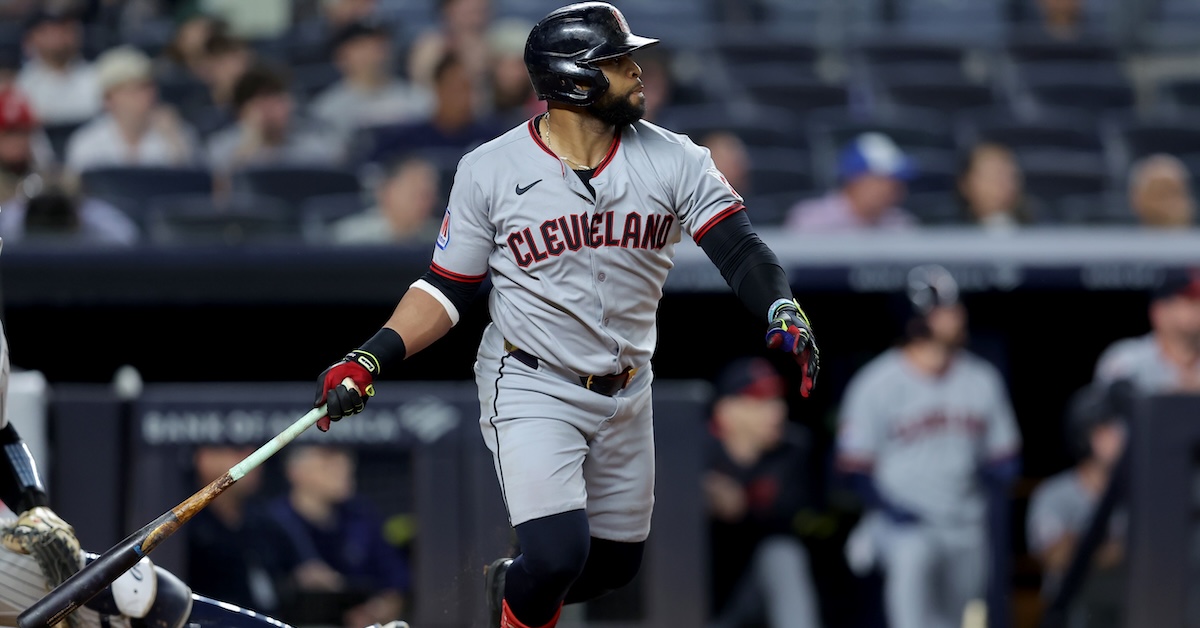
Creator’s be aware: 5 Issues will return subsequent week. Within the meantime, take pleasure in an article about one among my favourite gamers.
Do you need to understand how a lot Carlos Santana loves enjoying baseball? From 2020 via 2023, he performed for 5 groups, acquired traded midseason twice, and compiled a 94 wRC+. He was 37, had earned greater than $100 million in his profession, and didn’t have an apparent on a regular basis beginning job lined up. He might have hung up his spikes proper then – however he took a one-year, $5.5 million cope with the Twins and turned again the clock with a 114 wRC+. Then he signed one other one-year deal, this one for $12 million with the Guardians, and saved the practice rolling. By way of the primary third of the season, he’s on tempo for his finest 12 months in additional than half a decade.
What’s his secret? As a fellow 39-year-old, I needed to seek out out – for, you recognize, principally skilled causes, but additionally as a result of typically my knees harm after happening a very brisk stroll. Dangerous information for me, although. I’ve discovered one factor that Santana has achieved in 2025 to rejuvenate himself, and I’m undecided that I can replicate it in my private life.
Let me clarify. When you take a look at Santana’s Baseball Savant percentile rankings, you received’t come away impressed:
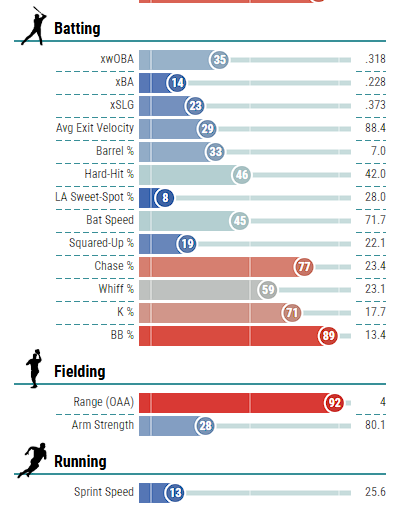
Sure, we get it, the person has an elite sense of the strike zone, and he’s nonetheless nice at protection — no large shock — nevertheless it’s a little bit of a bummer if we glance solely on the bar graphs above Chase%; there’s not a ton of loud contact, not a ton of squared-up contact, and he’s not often hitting the ball on the candy spot. That’s plenty of blue for a man working a 123 wRC+ and getting an article written about his late-career resurgence.
To know what’s happening right here, it’s a must to look a bit nearer. Santana is a switch-hitter, however lately, he was doing most of his harm whereas batting right-handed. From 2020 to 2024, Santana posted a 124 wRC+ in opposition to left-handed pitchers and an 89 wRC+ in opposition to right-handers. This 12 months, then again, he’s teeing off when he will get to bat lefty, to the tune of a juicy 130 wRC+ and all seven of his homers. He hasn’t confronted a ton of lefty opposition and thus hasn’t batted righty fairly often, however he’s solely managed a 99 wRC+ there.
The primary lesson right here is one that you just inevitably study in baseball: Arbitrary-endpoint splits are risky. What’s so particular about 2020 via 2024? What’s so particular in regards to the first few months of 2025? Why ought to we count on a loud sport like baseball to cease being noisy once we zoom in? The one fixed is change, and splits like these fly round even with out modifications in true expertise degree.
That mentioned, let me present you a distinct cut up. These are all numbers on contact, for context, however listed here are two totally different subsets of Santana’s efficiency in opposition to righty pitching in 2025:
Carlos Santana, Batted Ball Splits vs. RHP, 2025
| Break up | BA | SLG | wOBACON | xSLG | xwOBACON | EV | HH% | Barrel% |
|---|---|---|---|---|---|---|---|---|
| Good | .424 | 1.061 | .628 | .809 | .491 | 94.0 | 55% | 18% |
| Dangerous | .091 | .182 | .106 | .089 | .061 | 79.7 | 8% | 0% |
You’d fill your staff with any variety of clones of the primary man. The second man won’t make it in Double-A. I left it clean so you may briefly guess at what separates the 2, however not for lengthy: The desk reveals his efficiency on balls hit within the air, cut up by pulled aerial contact on the highest row and opposite-field aerial contact on the underside. That’s how you find yourself with this batted ball spray chart:
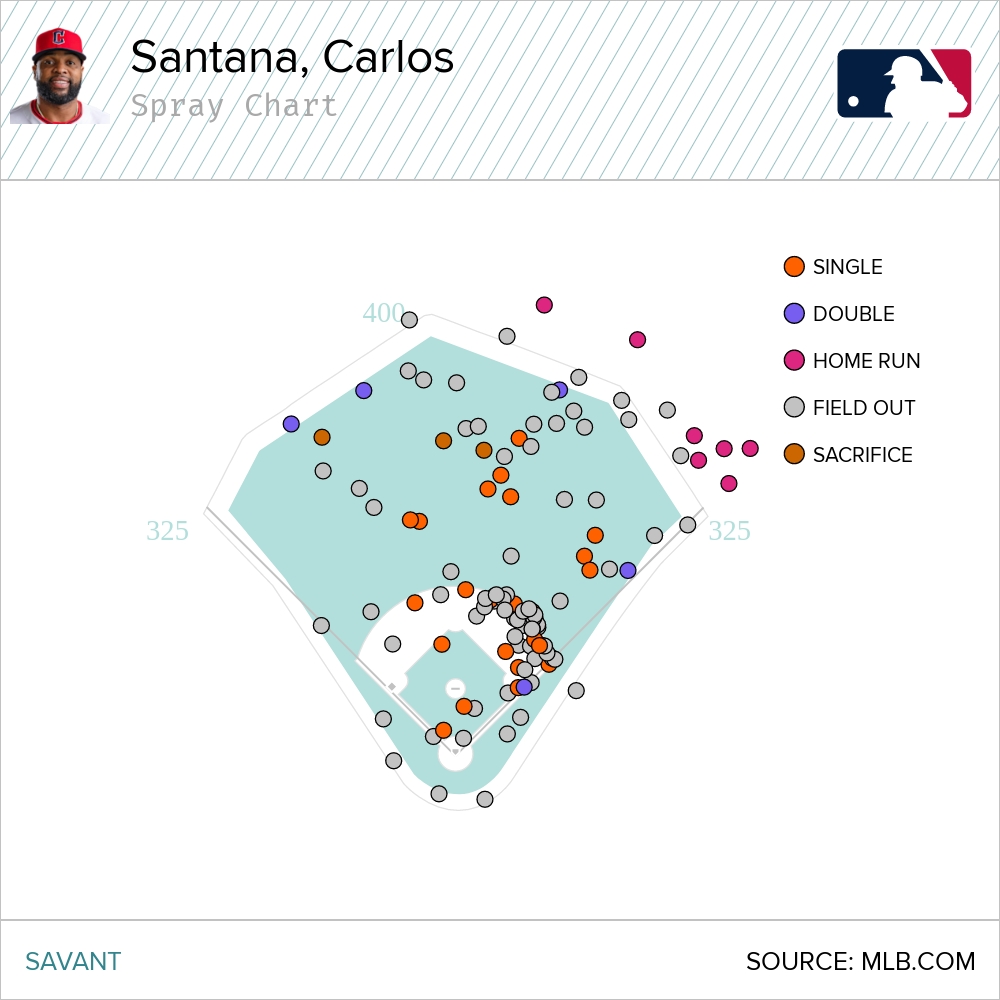
Certain, Ben, you would possibly say. We’ve already heard in regards to the pulled fly ball revolution. We all know that hitters do higher once they pull the ball than once they don’t. However I feel that understates simply how a lot Santana is promoting out to tug. For instance, take into account the unfold in exit velocities: 295 hitters have put 10 balls within the air to either side of the outfield, and Santana’s 14.3-mph hole in common exit velocity is the sixteenth largest. The league-average hole is round seven miles an hour. That’s only one metric, however the identical common sample holds for every part. The purpose right here is just not that each hitter performs higher to the pull facet; somewhat, it’s that Santana performs particularly higher to the pull facet.
That’s clear from the place he hits his homers. Right here’s one thing else that may not be instantly evident, although: Along with doing extra harm when he pulling the ball, Santana can also be pulling it extra often. Focusing solely on his lefty plate appearances, he’s pulling the ball within the air extra often this season that he has in every other 12 months throughout his profession. His earlier excessive? That’d be 2024. The flip facet is in fact true, too: He’s by no means gone to the alternative area lower than he’s now. It’s additionally not a coincidence that this 12 months and final are the 2 seasons during which Santana has posted his largest gaps in touch high quality between pulling the ball and going the opposite method. Extra of his hits are heading to proper area, and he’s changing into extra fearsome when he hits the ball that method (and hitting with even much less authority when he goes oppo).
You would possibly acknowledge this common sample because the Isaac Paredes method. Hitters with good-but-not-great energy – Santana matches that mildew – can’t simply blast homers to each distant nook of the park. They have a tendency to do higher if they’ll focus all of their finest contact to the components of the ballpark the place the outfield fence is nearer, and it actually helps that nearly each batter naturally hits the ball more durable to the pull facet.
Right here’s a desk from an earlier article I wrote about Paredes:
wOBA by velocity and course
| Exit Velocity | Pull | Straightaway | Reverse |
|---|---|---|---|
| <90 | .091 | .107 | .084 |
| 90-95 | .214 | .015 | .050 |
| 95-100 | .812 | .079 | .289 |
| 100-105 | 1.043 | .598 | 1.082 |
| 105+ | 1.853 | 1.505 | 1.728 |
Fly balls solely, 2023
The related a part of the chart right here is 95-100 mph, and to a lesser extent 100-105 mph. That’s how laborious Santana typically hits it when he makes good contact. He’s not ever going to be Aaron Decide or Giancarlo Stanton; as we already coated, his laborious contact and barrel charges are meaningfully decrease than league common. They’ve been for half a decade, in actual fact. To show so-so contact high quality into manufacturing, he has to intention for the pull facet. That explains loads in regards to the distinction between Santana’s Statcast anticipated numbers and his real-life manufacturing; he’s disproportionally hitting the ball to part of the ballpark the place he can get essentially the most bang for his exit velocity buck.
Need a clear signal that that is an intentional change? Every thing about Santana’s sport has tilted that method. He’s swinging extra usually at inside pitches, and pulling them loads when he does swing. When he hits a pitch down the center, he’s pulling it on the second-highest price of his lengthy profession. When he hits a fastball down the center, the identical is true. He’s swinging much less often at exterior pitches – it’s more durable to tug these – however he’s additionally pulling them greater than ever when he makes contact with them. He’s develop into one of the crucial extraordinarily out-in-front lefty hitters in baseball, as measured by the common angle of his bat when he makes contact with the ball – eight levels to tug, a top-15 mark amongst all lefty hitters within the majors.
I’m notably eager about Santana’s new method due to his present ability. Santana is among the nice strike zone knowers of the twenty first Century. He’s walked greater than 1,000 instances within the main leagues, in a ridiculous 14.5% of his profession plate appearances (he solely strikes out 16.5% of the time). He combines stable contact abilities with a preternatural capacity to establish pitches rapidly; if Mr. Santana thinks it’s not a strike, the percentages are that it isn’t a strike. Traditionally, although, when he recognized a pitch to swing at, he labored again up the center — hitting it to heart or possibly right-center if he was notably on the ball. Right here’s the place he hit the ball as a lefty in 2019, his final nice season of left-handed manufacturing earlier than his current resurgence:
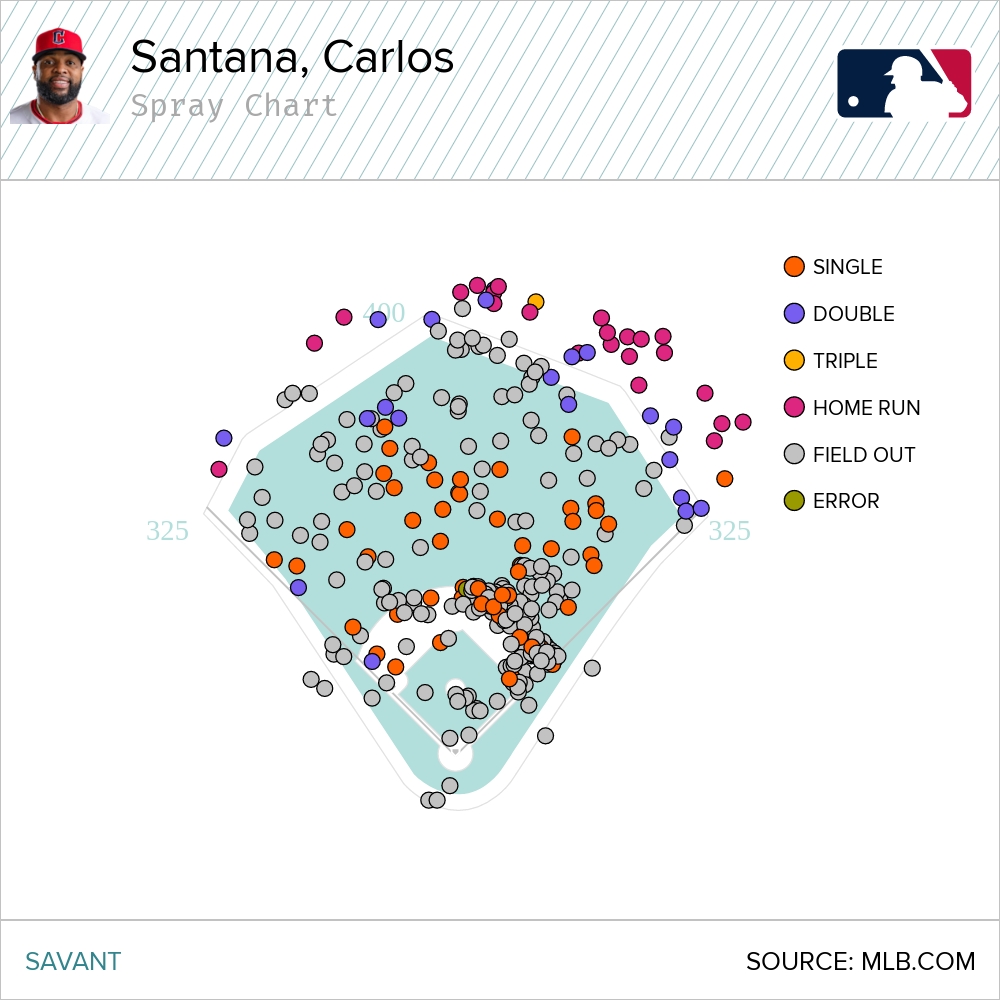
Now, the sport’s a bit totally different: Santana seems to be turning his pitch identification abilities to discovering balls to tug. He’s sacrificing elsewhere to take action: When he hits the ball wherever aside from the pull facet this 12 months, it’s with the least authority he ever has. If he weren’t so good at pitch identification, I don’t assume this ability would work. His teammate Jhonkensy Noel, simply to offer you an instance, is hammering his pulled contact this 12 months, far in extra of how laborious he hits it to the alternative area, and pulling extra balls than he sends the opposite method. He’s additionally placing out a 3rd of the time and by no means strolling, resulting in a 12 wRC+.
I’m undecided how lengthy Santana can maintain this up. It appears like a ploy, a “one silly trick pitchers can’t stand” that will likely be revealed as a gimmick after opponents spend sufficient effort studying to counter his tactic. In the long term, it’s laborious to make this work. However who cares? As John Maynard Keynes mentioned, in the long term we’re all lifeless. 4 years in the past, it regarded like Santana is perhaps on his method out of baseball. In 2025, he’s batting cleanup for a playoff contender and crushing righties in addition to he ever has in his lengthy, glorious profession. Signal me up for that sort of one silly trick day-after-day of the week.