
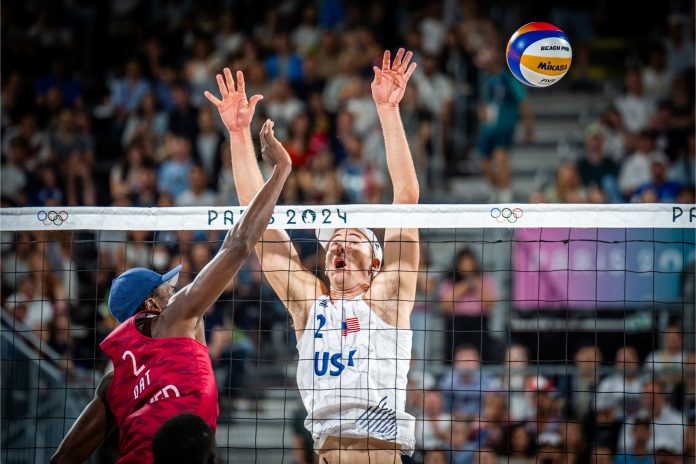
Andy Benesh and Miles Partain picked the hill — or sword, to make use of their parlance — they might die on within the Paris Olympic Video games.
It’s a very good phrase selection, sword. Their type of play — excessive passes, an on-two and jump-setting frequency that will make even Sweden blush — is excessive threat, excessive reward, the distinction between successful and dropping roughly as razor skinny because the blade of the sword Benesh declared they’d dwell and die on in Paris.
On Wednesday night in Paris, in a quarterfinal match towards Qatar’s Cherif Younousse and Ahmed Tijan, they proudly exited the Olympics on that very sword, dropping 14-21, 16-21.
The rating is indicative of how the match went. Qatar, as they’ve been all week, was dominant, borderline good. Cherif and Ahmed hit simply eight errors to the USA’s 16, tallied only one service error to the USA’s six, dug eight balls to the USA’s 5, and notched 26 kills to the USA’s 22.
There isn’t a dropping with these numbers.
But for Partain and Benesh, there will likely be no regrets. No what-ifs.
That is the type that obtained them to Paris. That is the type that pushed them into the quarterfinals after a convincing 21-17, 21-18 sweep over Italy’s Sam Cottafava and Paolo Nicolai. That is what they’ll be doing, as Partain mentioned after a pool play win over Brazil’s George Wanderley and Andre Loyola, “for eternity.”
Typically the sword suggestions barely within the incorrect course.
It was an intriguing matchup coming in. Cherif and Ahmed have among the finest monitor information towards Sweden’s David Ahman and Jonatan Hellvig amongst any workforce on the planet. Each matchup between the 2 has gone three units, together with the match of those Olympic Video games, a 20-18 three-set win for Qatar. Cherif is cellular sufficient to trace the choice and the jump-set, and Ahmed quick-twitch sufficient to choose up a lot of what will get behind him. Benesh and Partain are the closest similar to Sweden as there may be on the planet.
Qatar was prepared.
Cherif piled up 5 blocks and is now No. 3 for the match, behind Hellvig and Germany’s Nils Ehlers, regardless of solely as soon as going three units. Ahmed’s seven digs vaulted him to tops within the discipline, 5 forward of Ahman and 7 greater than Norway’s Christian Sorum, who’s within the different semifinal.
Offensively, they have been great. They handed almost good, permitting zero aces towards one of many hardest serving groups within the discipline. Partain was restricted to 2.5 digs per set, that means any earned factors just about needed to come from the block of Benesh. His 5 blocks have been admirable, however not sufficient. Not sufficient to beat the rash of errors that often comes with the on-two, jump-setting type with which they play, and certainly there was a rash of them, 16 in whole.

The USA, then, is out of the match, and Paris will mark the primary Olympic Video games in historical past that america won’t medal in seashore volleyball. For the boys, this extends a drought that dates again to 2008, when Phil Dalhausser and Todd Rogers received gold.
Since, the American males haven’t even made a semifinal.
The ladies, too, are off the rostrum for the primary time since 2004, with Kelly Cheng and Sara Hughes bowing out in fifth, and Kristen Nuss and Taryn Kloth settling for a stunning ninth.
With the absence of Individuals, there’s a hole for historical past to be made elsewhere.
Melissa Humana-Paredes, Brandie Wilkerson make historical past
Melissa Humana-Paredes and Brandie Wilkerson, now taking part in the position of adopted Individuals with each of the USA groups eradicated, are into the semifinals after a 21-18, 21-18 win over Spain’s 22-year-old phenoms Daniela Alvarez and Tania Moreno. They’re the primary Canadian ladies’s workforce to make an Olympic semifinal, and can now have two pictures at Canada’s first ladies’s medal — John Childs and Mark Heese received bronze for Canada in 1996 — the primary coming in Thursday’s semifinal towards Switzerland’s Nina Brunner and Tanja Huberli, who’re likewise of their first Olympic medal spherical.
“Each single workforce right here is of fantastic calibre, so each time it’s a troublesome sport,” Wilkerson instructed Volleyball Canada. “However fortunately we’ve confronted a whole lot of challenges earlier than attending to this… I’m happy with our workforce and our resilience and grit.”
Sweden earns rematch with Qatar in Olympic seashore semifinals
Resilience and grit are apt phrases to explain Sweden’s David Ahman and Jonatan Hellvig. Coming into Paris, they have been the odds-on favorites to win, surpassing even Norway’s Anders Mol and Christian Sorum, the defending gold medalists.
Then, to the shock of the collective seashore volleyball world, they dropped two matches in pool play. But they’ve rebounded properly, beating Cuba’s Jorge Alayo and Noslen Diaz and sweeping Brazil’s Evandro Goncalves and Arthur Mariano, incomes a rematch with Qatar’s Cherif Younousse and Ahmed Tijan in Thursday’s nightcap semifinal.
Norway’s Mol-Sorum, Brazil’s Ana Patricia and Duda looking for Olympic podium
The opposite semifinal required, on paper, little resilience or grit. Mol and Sorum have but to drop a set in Paris, sweeping Spain’s Adrian Gavira and Pablo Herrera, 21-16, 21-17. Ehlers and Wickler, of their sixth semifinal of 2024, have misplaced only one set, to Australia’s Thomas Hodges and Zach Schubert, however are additionally undefeated.
Extra convincing, maybe, than any workforce within the discipline, males or ladies, is Brazil’s Ana Patricia Silva and Duda Lisboa.
Coming off a tough stretch of three consecutive tournaments with no podium – this, for them, is taken into account a tough stretch – Ana Patricia and Duda have been tearing via groups, the newest being Latvia’s Tina Graudina and Anastasija Samoilova. A 21-16, 21-10 is the newest sweep, and people scores are hardly uncommon. Solely Egypt, of all groups, has come inside two of Brazil.
The subsequent workforce to attempt will likely be Australia’s Taliqua Clancy and Mariafe Artacho, who’re looking for a second straight Olympic medal after claiming silver in Tokyo.
