
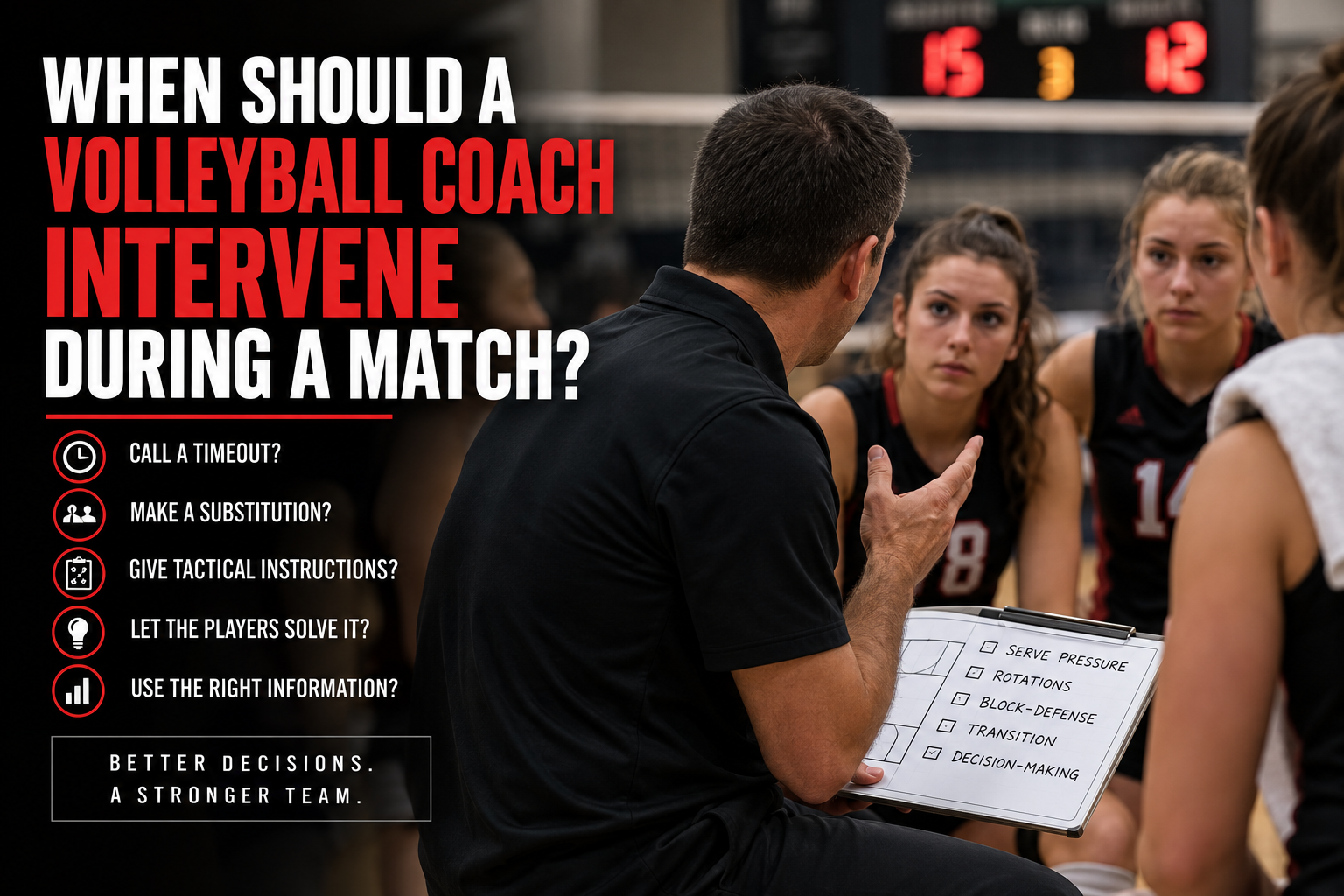
One of many hardest issues for a coach throughout a match is figuring out when to step in to take a timeout, make a sub, or present instruction.
You see one thing going incorrect. Possibly a rotation is struggling, the opponent is on a run, a hitter is making poor selections, or your serve obtain is beginning to break down. The intuition is usually to do one thing.
Typically that’s precisely proper. Typically the higher resolution is to depart it alone.
The bottom line is separating an issue that wants intervention from one the gamers can (and may) resolve themselves. Not each drawback wants a training response. Matches are messy. Gamers make errors, opponents make good performs, and momentum shifts.
If you happen to reply to each unfavorable occasion, you threat turning the match into a continuing stream of directions. That may make gamers extra depending on the bench slightly than extra able to fixing issues themselves. It additionally tends to make them overthink, which most likely simply exacerbates the problem slightly than helps it.
The query that you must ask is whether or not this truly an issue, or simply a part of the regular variation of a match.
Search for patterns, not remoted errors
As I mentioned in What Volleyball Coaches Ought to Watch Throughout a Match, coaches want to observe for repeated patterns slightly than react to particular person rallies. The identical precept applies to intervention.
If one passer will get aced as soon as, that doesn’t essentially require a change. If the identical passer is repeatedly getting focused and breaking down, now you’ll have one thing to handle.
If one rotation loses two factors, that may imply little or no. If that very same rotation constantly struggles to facet out, or repeatedly provides up lengthy serving runs, then intervention turns into extra justified.
The extra confidence you will have that the issue is actual and recurring, the stronger the case for performing.
Ask whether or not the gamers already know
Earlier than stepping in, take note of what the gamers are doing. Are they speaking to one another? Are they adjusting their positioning? Has the setter already modified a choice sample? Are blockers speaking about what they’re seeing?
If the gamers acknowledge the problem and are attempting to resolve it, your intervention could add little or no. In actual fact, interrupting them can generally get in the best way.
One of many objectives of teaching is to develop gamers who can establish issues and adapt in actual time. If you happen to all the time present the answer first, they’ve fewer alternatives to develop that skill.
Timeouts ought to have a transparent objective
Timeouts are most likely the obvious type of in-match intervention. They might even have much less worth than individuals are inclined to suppose. Too typically they get used just because the opponent has scored a number of factors in a row.
A run itself isn’t essentially the problem, nevertheless. Earlier than taking a timeout, it’s best to ask what am I going to vary throughout this timeout?
Possibly that you must reinforce a serving goal. Maybe the gamers have stopped executing a defensive duty. Possibly one rotation has grow to be disorganized and must be reset. A timeout can be helpful if the gamers are emotionally unraveling and want a second to settle.
If you happen to don’t have a transparent message or adjustment to make, although, calling timeout could merely interrupt the match with out truly serving to.
Don’t overload gamers through the timeout
Even when intervention is required, the quantity of data issues. A timeout is just not a mini teaching clinic.
Gamers are already processing the rating, the opponent, their very own efficiency, and what simply occurred on the courtroom. Giving them 4 or 5 completely different directions normally means little or no will get retained.
One or two clear factors are usually sufficient. That is perhaps a tactical reminder, a positional adjustment, or a easy cue about what the opponent is doing.
The purpose is to enhance the subsequent few rallies, not repair your entire match in thirty seconds.
Substitutions ought to resolve an issue
Substitutions are one other space the place coaches can really feel strain to behave.
A participant makes a mistake, then one other one, and the intuition is to interchange them. Typically that’s acceptable. The query is whether or not the substitution truly improves the scenario.
Are you altering a matchup? Strengthening serve obtain? Enhancing blocking? Giving the offense a special attacking possibility? Bringing in a server for a particular tactical purpose?
These are clear functions. Substituting just because somebody made a mistake is completely different. If gamers imagine each error would possibly get them taken out, they might grow to be extra cautious slightly than more practical.
Watch out with tactical over-coaching
It’s straightforward to see a tactical sample and instantly begin directing gamers.
- Serve right here.
- Set this hitter.
- Block line.
- Tip quick.
A few of that’s helpful. An excessive amount of, nevertheless, could make gamers reactive to the bench slightly than aware of what’s occurring in entrance of them. The very best tactical interventions normally assist gamers acknowledge one thing slightly than merely inform them what to do.
For instance, as a substitute of repeatedly calling a serving zone, you would possibly remind the server what the opponent’s passing sample seems like and allow them to make the choice. That retains the gamers concerned within the problem-solving course of. I wrote extra about that matter in Is asking service targets useful?
Typically the proper intervention is emotional
Not each helpful intervention is tactical. A participant may have reassurance after a troublesome stretch. The workforce could have to regain composure. A substitute may have a quite simple reminder earlier than coming into the match.
That doesn’t imply giving a motivational speech each time momentum shifts. It means recognizing when the problem is confidence, communication, or emotional management slightly than technique. In these moments, the most effective intervention could also be very quick.
Think about the price of intervening
Each intervention has a price.
A timeout makes use of one in all a restricted quantity obtainable. A substitution adjustments personnel and should have an effect on later choices. An instruction can pull a participant’s consideration away from one thing else. Even a fast remark from the sideline can add one other piece of data they need to course of.
That doesn’t imply it’s best to keep away from intervening. It means the intervention ought to be value the fee.
Let the match train you one thing
One purpose coaches intervene too shortly is discomfort with watching gamers battle. However battle provides you data.
If you happen to let a rotation play by way of a troublesome stretch, you learn the way the gamers reply. If you happen to let a setter work by way of a poor resolution sample, you see whether or not they acknowledge it.
That data could be useful later within the match and in future coaching. You might not need to let a match get away from you simply to make a developmental level, however you additionally shouldn’t search to rescue the workforce from each troublesome second.
Intervention ought to make the workforce more practical
In the end, the aim of intervention is to not show that the coach sees the issue. It’s to assist the workforce carry out higher.
Typically meaning calling timeout.
Typically it means making a substitution.
Typically it means giving one clear tactical cue.
And generally it means doing nothing.
The higher you grow to be at distinguishing between these conditions, the extra helpful your in-match teaching turns into.