
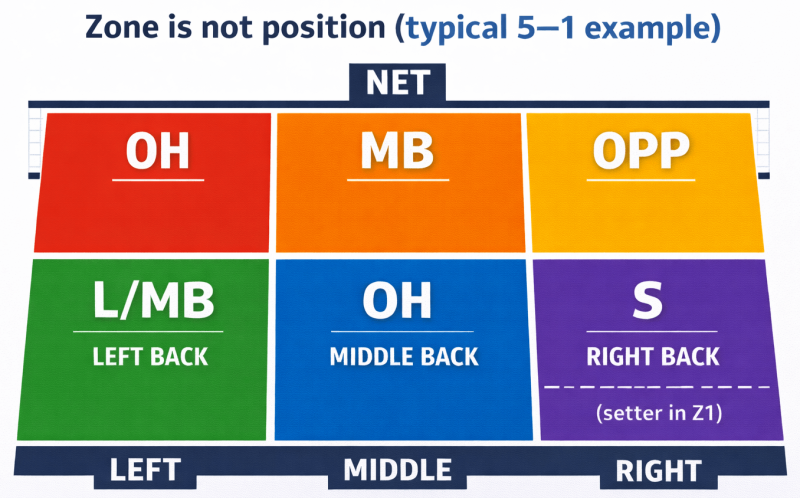
Volleyball zones are the six numbered areas in your facet of the courtroom: 1–6. Zones let you know the place a participant is on the ground at a second in time. Positions (setter, OH, MB, and many others.) describe a participant’s position/job, not their zone. The courtroom can also be cut up into entrance row (zones 2–3–4) and again row (zones 1–6–5), which issues for who can block and who can assault above the web. Most confusion comes from mixing up rotation order, beginning positions, and zones.
Associated:
- Rotations, lineups & courtroom mapping hub (Begin right here)
- Volleyball set diagram
- 5–1 beginning rotation information
What are volleyball zones? (1–6)
On your facet of the web, we quantity the zones like this:
- Zone 1 = proper again (RB)
- Zone 2 = proper entrance (RF)
- Zone 3 = center entrance (MF)
- Zone 4 = left entrance (LF)
- Zone 5 = left again (LB)
- Zone 6 = center again (MB)
| Zone | Frequent title | Abbrev |
| 1 | Proper Again | RB |
| 2 | Proper Entrance | RF |
| 3 | Center Entrance | MF |
| 4 | Left Entrance | LF |
| 5 | Left Again | LB |
| 6 | Center Again | MB |
In most teaching diagrams, you’re wanting on the courtroom with your staff on the underside and the internet on the prime, as you’ll be able to see within the diagram above.
Key level: Zones are mounted areas of the courtroom. They don’t change as a result of your lineup modifications.
Entrance row vs again row (and what modifications)
The entrance/again row cut up is the only “rules-relevant” method to consider zones:
- Entrance row: zones 2, 3, 4
- Can block (and may full a block).
- Can assault a ball that’s above the highest of the web from wherever (so long as they’re not illegally crossing the middle line, and many others.).
- Again row: zones 1, 6, 5
- Can’t block or try to dam.
- Can assault, but when the ball is totally above the highest of the web, the participant should take off from behind the assault line (10-foot/3-meter line).
- Again-row gamers can assault from in entrance of the road if the ball isn’t utterly above the web.
A helpful teaching shortcut:
- Row standing follows the rotation, not the position. Your setter could be entrance row or again row; similar for outdoor hitters, opposites, and many others.
Rotation vs place vs zone (frequent confusion)
These three phrases get used interchangeably in gyms, which could be complicated at occasions.
Zone = the place they’re
“Setter is in Zone 1.”
Which means the setter is presently in proper again.
Place (position) = what they do
“Setter units. Center blocks center. OH passes/assaults left pin.”
That’s their job description, not their authorized spot on the courtroom. Beneath is a typical 5-1 positioning diagram as soon as gamers transfer to their enjoying positions from their rotation place.

Rotating = the order gamers transfer via zones
Rotating is just the staff transferring clockwise when successful the serve after receiving.

Why this issues for overlap: The overlap rule cares about relative positions at serve contact – or toss, relying on the principles you employ – (proper/left and entrance/again relationships), not about what you name somebody (setter/outdoors/center). This is the reason “zone ≠ place” is such a giant deal if you’re instructing rotations and overlap.
Rotation X = the staff’s present rotational place
Coaches usually say “Rotation 1,” “Rotation 5,” and many others. to label which of the six rotational states a staff is presently in. The complicated half is that these labels aren’t common.
One frequent strategy is sequence-based: Rotation 1 = the rotation you began the set in; Rotation 2 = after one rotation; and so forth. (In lots of gyms, groups additionally select to begin so the setter is in Zone 1, which makes Rotation 1 = “setter in Zone 1,” however that’s a selection—not a rule.)
One other frequent strategy (particularly when the main target in on a 5-1 system) is setter-location-based: Rotation 1 = setter in Zone 1, Rotation 2 = setter in Zone 2, and many others.
To keep away from confusion, I normally check with rotations as “setter in Zone X” (or “S in 1,” “S in 6,” and many others.), which is unambiguous.
For those who’re instructing this to gamers, the complete walk-through is within the Rotations hub.
Zones in serve obtain (why coaches nonetheless discuss “zone 1”)
Coaches preserve saying “serve to zone 1” though serve obtain formations don’t appear to be the six-zone diagram. That’s as a result of zone language remains to be a clear shorthand for:
- Focusing on house (seam/brief/deep)
- Predicting first contact choices (who’s more likely to move)
- Setting/attacking tendencies (the place the ball is more likely to go subsequent)
Two necessary clarifications:
- In serve obtain, gamers begin of their rotational zones (so that you’re authorized), then they’ll transfer because the server contacts (or tosses) the ball.
- When somebody says “zone 1 serve,” they normally imply “deep right-back space” on the receiver’s facet—not that the passer is standing precisely in rotational Zone 1.
Frequent errors coaches/gamers make
- Instructing zones as in the event that they’re roles: “Zone 1 is the setter spot.” (Typically true in a selected rotation; not true as a rule.)
- Not anchoring orientation: layers flip zones of their head when switching sides. Zones are at all times labeled relative to your facet of the web (your courtroom), not the fitness center
- Complicated “proper again” with “Zone 1”: Proper again is a named space that corresponds to Zone 1 in your facet, however in serve obtain/protection you might be “proper back-ish” with out standing precisely within the zone field.
- Mixing up Zone 6 vs “center again defender”: Zone 6 is the middle-back space; “center again” in protection would possibly shift relying on scheme, hitter location, and skim obligations.
- Overlap instructing that ignores zones: Overlap is best when gamers know their zone relationships (who have to be left/proper of whom; who have to be in entrance/behind whom) at serve contact.
FAQs
What’s Zone 1?
Zone 1 is correct again (RB) in your facet of the courtroom.
What’s Zone 2?
Zone 2 is correct entrance (RF) – the front-right space close to the web.
What’s Zone 3?
Zone 3 is center entrance (MF) – middle of the entrance row.
What’s Zone 4?
Zone 4 is left entrance (LF) – the left pin space close to the web.
What’s Zone 5?
Zone 5 is left again (LB) – deep left space of the again row.
What’s Zone 6?
Zone 6 is center again (MB) – middle of the again row.
Is Zone 1 at all times the setter spot?
No. Zone 1 is a courtroom space, not a job. In some rotations (and a few methods), the setter could also be in Zone 1, however the setter rotates via all six zones like everybody else.
Are zones the identical in serve obtain and protection?
The zone map is at all times the identical, however gamers should not have to face “within the packing containers” as soon as the ball is contacted. Serve obtain and protection usually use zone language to explain areas or targets, not precise rotational beginning spots.
What does “proper again / left entrance” imply?
These are named areas of the courtroom:
- Proper again = Zone 1
- Left entrance = Zone 4
They’re helpful as a result of they’re intuitive (proper/left, entrance/again) and map cleanly to zones.
Why do some diagrams use numbers and others use positions?
Numbers (zones) present the place, positions present who/position. Coaches will usually overlay them (e.g., “OH in Zone 4”) to show each without delay.
How do zones relate to rotations?
Rotation strikes gamers clockwise via the zones: 1 → 6 → 5 → 4 → 3 → 2 → 1. Your lineup’s rotation order determines who results in which zone every rally.
What zones can assault in entrance/again row?
- Entrance row attackers (zones 2–3–4) can assault a ball that’s utterly above the web from wherever.
- Again row attackers (zones 1–6–5) can assault, however should take off from behind the assault line if contacting a ball that’s utterly above the web.
How do zones map to five–1 rotations?
In a 5–1, the setter rotates via all zones like everybody else. The important thing mapping is: when the setter is entrance row (zones 2–3–4), you have got three front-row attackers; when the setter is again row (zones 1–6–5), you have got two front-row attackers plus back-row choices.
***
The submit Volleyball Zones & Courtroom Positions (with diagrams) appeared first on Teaching Volleyball.