
Most free agent contracts are comparatively simple to foretell. Calculate the going fee for a single win, multiply it by the participant’s projected wins above alternative over the size of the deal, and the consequence will come fairly near the precise contract. This usually holds true for each sort of participant save one: the common-or-garden reduction pitcher.
The Mets gave Luke Weaver $22 million for 2 years. The Tigers gave Kenley Jansen $11 million for his age-38 season. The Reds gave Emilio Pagán two years and $20 million, with the second yr a participant choice. Run the entire reliever contracts signed this offseason by way of a {dollars} per win calculation, and so they’re virtually uniformly going to come back out wanting like horrible offers.
The game seems to be smarter than ever, and but groups hold shelling out gobs of assured cash on bullpen arms who hardly prime 2 WAR. What’s their downside? Effectively, perhaps groups have collectively determined to behave irrationally in a single particular market, however I don’t suppose it’s that. I believe groups are behaving as rationally within the reliever market as another, however they occur to be utilizing a unique metric for evaluating reliever offers. The related metric, I believe, isn’t {dollars} per win, however one thing like championship win likelihood added.
Within the 2025-26 offseason, I calculated that groups have paid roughly $8 million per projected win for beginning pitchers and place gamers. Right here I’ll notice that for multi-year offers, I ignored years after 2026, merely calculating the upcoming season’s {dollars} per win. Different calculations factoring within the efficiency decline of gamers on multi-year offers have are available in larger, however the level is to ascertain an apples-to-apples baseline with relievers. Additionally, I used the AAVs in our Free Agent tracker, that are adjusted for deferrals. Lastly, my knowledge set for each relievers and non-relievers contains all offers signed as of January 10 – my apologies to Pierce Johnson.
Even for non-relievers, {dollars} per win has all kinds of points as an analysis framework. As many baseball analysts have noticed through the years, there’s good motive to consider that wins should be valued in a nonlinear style. A participant projected for 2 wins could be value $16 million for a single yr’s work, however a participant projected for 4 wins is probably going value a very good bit greater than $32 million, whereas a participant projected for a single win might be value a bit lower than $8 million.
The reason being the shortage of each gamers and roster spots. 4-win gamers are practically not possible to search out on waivers or hanging round in Triple-A; that’s much less true of gamers who can produce 1-2 WAR. On Bluesky final week, Jonathan Choose of Baseball Prospectus additionally argued that those that receives a commission in free company represent a small and particular share of the participant pool, and so {dollars} per win solely has restricted applicability.
You Aren’t a FanGraphs Member
It seems such as you aren’t but a FanGraphs Member (or aren’t logged in). We aren’t mad, simply disenchanted.
We get it. You wish to learn this text. However earlier than we allow you to get again to it, we would prefer to level out just a few of the great the explanation why it’s best to develop into a Member.
1. Advert Free viewing! We can’t bug you with this advert, or another.
2. Limitless articles! Non-Members solely get to learn 10 free articles a month. Members by no means get lower off.
3. Darkish mode and Traditional mode!
4. Customized participant web page dashboards! Select the participant playing cards you need, within the order you need them.
5. One-click knowledge exports! Export our projections and leaderboards in your private initiatives.
6. Take away the pictures on the house web page! (Actually, this does not sound so nice to us, however some individuals needed it, and we like to offer our Members what they need.)
7. Much more Steamer projections! We’ve got handedness, percentile, and context impartial projections obtainable for Members solely.
8. Get FanGraphs Stroll-Off, a personalized yr finish assessment! Discover out precisely the way you used FanGraphs this yr, and the way that compares to different Members. Do not be a sufferer of FOMO.
9. A weekly mailbag column, completely for Members.
10. Assist assist FanGraphs and our complete employees! Our Members present us with crucial assets to enhance the location and ship new options!
We hope you will take into account a Membership at present, for your self or as a present! And we notice this has been an awfully lengthy gross sales pitch, so we have additionally eliminated all the opposite advertisements on this article. We did not wish to overdo it.
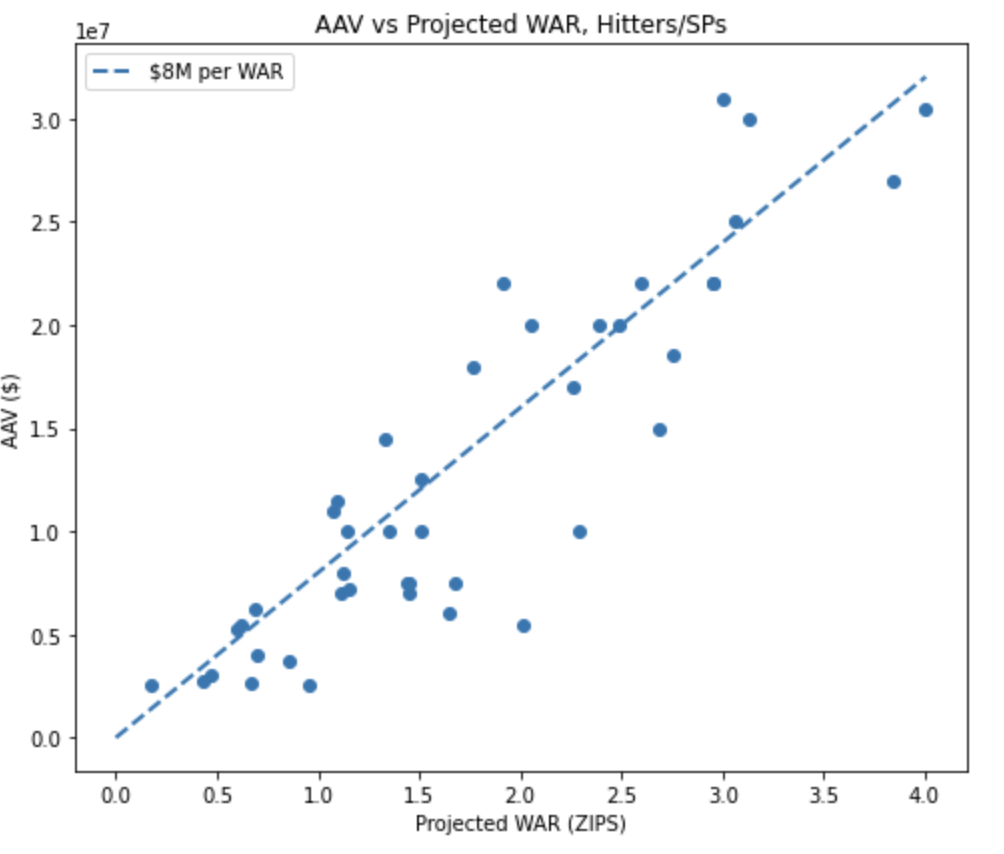
Even with these caveats, a linear software of {dollars} per win tends to elucidate the contracts of place gamers and beginning pitchers with a excessive degree of accuracy. Under is a plot of all of the 2026 hitter and beginning pitchers who’ve signed contracts with a mean annual worth (AAV) of a minimum of $2.5 million. On the x-axis is their projected WAR per ZiPS; the y-axis is their AAV. The blue line is an $8 million AAV. Because the plot exhibits, multiplying 2026 projected WAR by $8 million will get you fairly shut on virtually each contract signed:
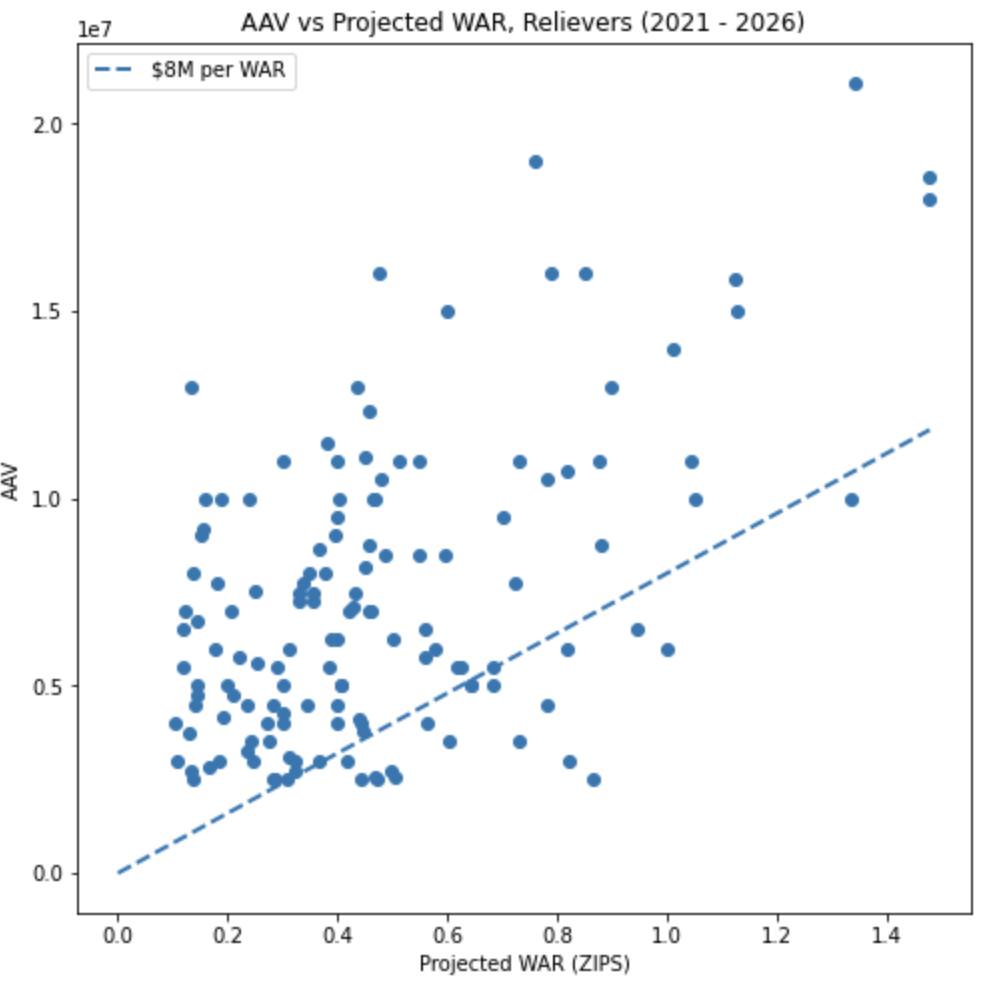
That isn’t the case with relievers. The plot under options all reliever contracts signed since 2021, with the identical $2.5 million AAV cutoff. Almost each deal lands above $8 million per win. The median reliever contract within the 2020s surpassed $15 million per projected win, practically double the going fee for place gamers and beginning pitchers:
None of those insights are significantly novel. Again in 2011, Jack Moore wrote a chunk for this website titled “Can WPA Clarify How Groups Purchase Relievers?” As Jack wrote, “merely declaring ‘groups are overpaying relievers’ advert nauseam does little or no to advance our understanding of how the sport really works,” and instructed a win likelihood framework may higher seize the whims of {the marketplace}.
In 2018, Russell Carleton expanded upon this theme in his story titled “Why Relievers Are Getting Paid.” Russell identified that “groups aren’t accumulating context-neutral wins,” which is what WAR kind of measures. In different phrases, the win that takes a staff from 88 to 89 wins is rather more useful than the one which takes them from 78 to 79. Relievers, Russell says, have the flexibility to swing “the video games that can make or break a season.”
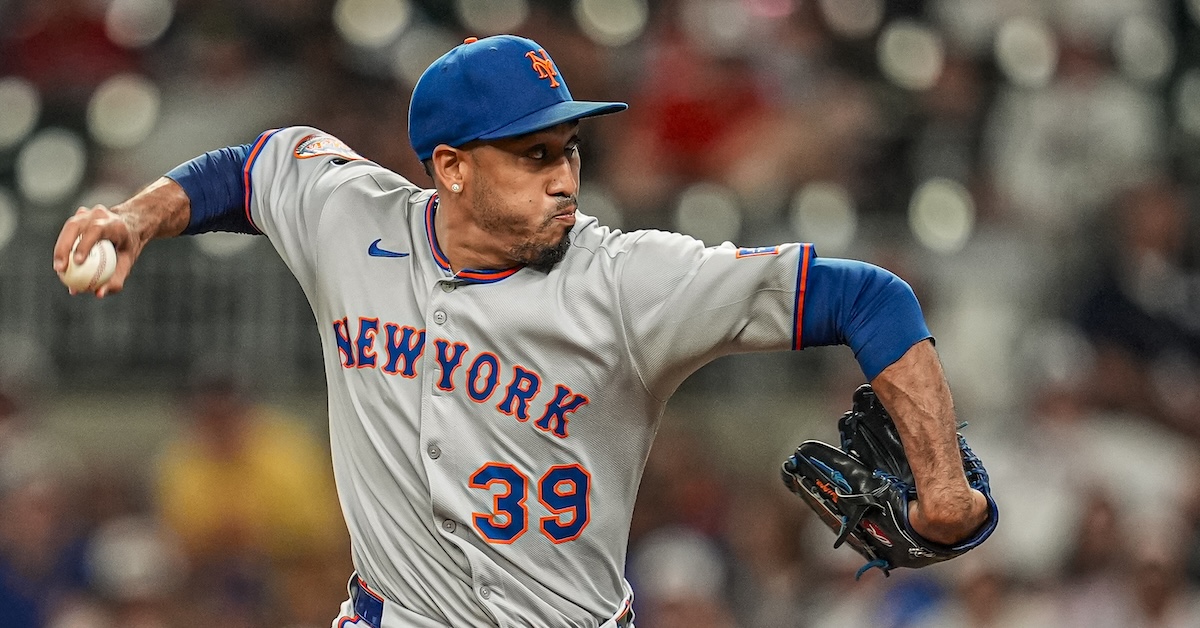
I’m going to take Russell’s thought one step additional. Aggressive groups will not be simply keen to pay excessive costs for high-leverage relievers as a result of they will make the distinction between playoffs and no playoffs. They’re paying for the playoff innings themselves. In different phrases, the Dodgers didn’t pay Edwin Díaz $69 million simply to ship a 2.25 FIP over 65 common season innings. He commanded a $23 million AAV as a result of, in the event that they occur to as soon as once more discover themselves within the tenth inning of World Collection Sport 7, they’ll have Díaz as a substitute of a beginning pitcher engaged on zero days relaxation. (Jarrett Seidler instructed one thing comparable final month, which received me occupied with this matter basically.)
Proving that groups are paying relievers by cWPA as a substitute of WAR presents a boatload of issues, not the least of which is most people tendency to solely mission common season statistics. Sadly, there’s probably not a approach round that — a projection can’t assume a participant will compete within the postseason in 2026, not to mention two or 5 or 13 years sooner or later. Largely that is high-quality, and also you wouldn’t essentially anticipate a participant to be considerably extra vital within the common season than the postseason, and so all of it makes roughly sufficient sense.
However this all breaks down for relievers. WAR, leverage-adjusted for relievers although it’s, can’t absolutely clarify the costs groups are paying for bullpen arms. It’s not that they don’t care how a man performs in April or July; that may go an extended method to whether or not you get to play in October, in spite of everything. However they’re additionally paying for a conditional: If we make the playoffs, then this participant may have disproportionate worth. On condition that, maybe one thing like cWPA will get just a little bit nearer to matching how they pay for different sorts of gamers.
As a result of there’s no simple method to do cWPA projections for relievers, I got here up with a roundabout method to account for this tendency. Taking that very same 2020s dataset of reliever contracts, I first created a easy linear regression mannequin that predicted reliever contracts utilizing solely projected WAR. That mannequin had an r-squared of 0.3; in different phrases, it predicted 30% of the variation in reliever contracts throughout this decade.
I then added the preseason playoff odds for the relievers’ signing staff into the mannequin. (For 2026 playoff odds, I created a proxy from Steamer projections; they aren’t excellent, however I believe they’re shut sufficient. I put them in a Google sheet if you wish to beef with them.) It wasn’t an enormous bounce, however the addition of playoff odds meaningfully improved the mannequin predictions. The r-squared jumped to 0.37; the bigger contracts particularly got here a lot nearer to the predictive line:
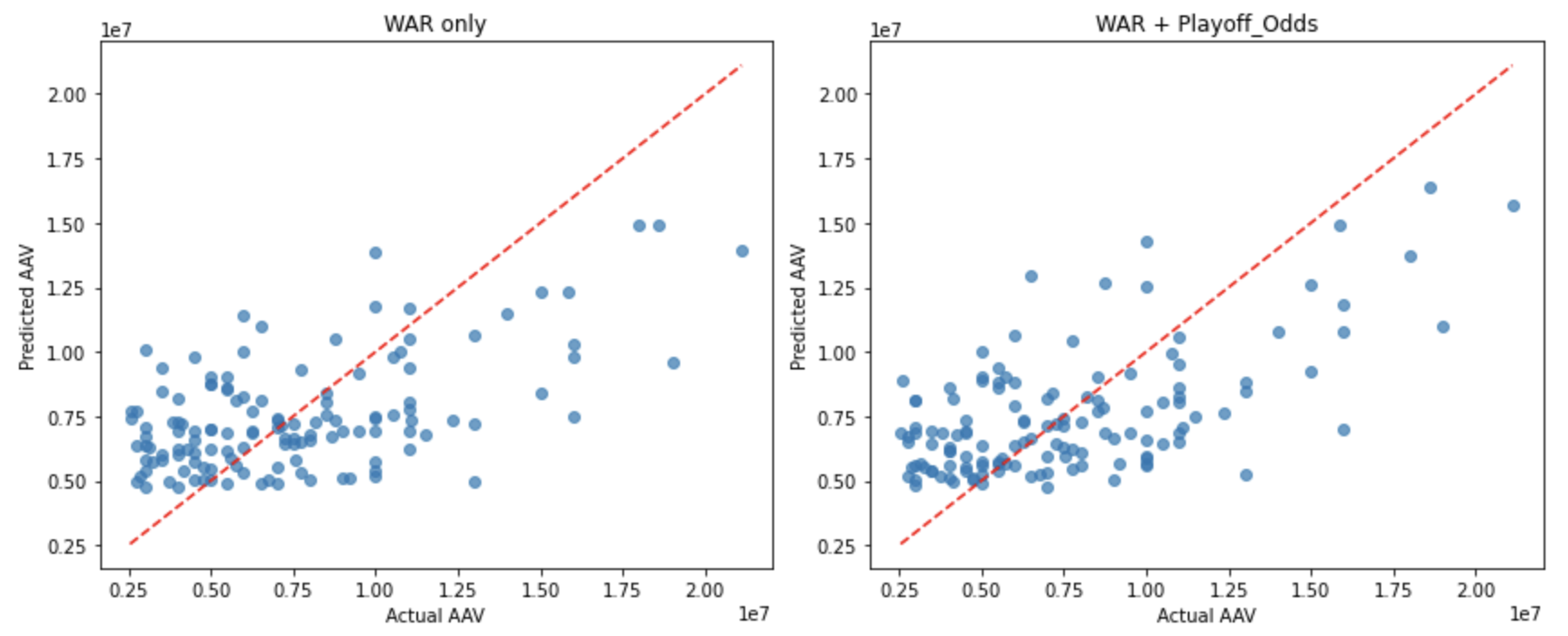
And this isn’t only a case of higher groups spending extra money. I carried out the identical train with the beginning pitcher and place participant dataset; including the playoff odds elevated the r-squared from 0.8 to 0.81. One might additionally argue that this mannequin merely captures the truth that solely playoff contenders can pay full market costs for reduction pitchers. However I don’t suppose that’s precisely proper both. As playoff odds — and due to this fact World Collection odds — improve, groups will spend marginally extra on every reliever, holding all else fixed. To me, this means a particular premium for relievers utilized to their projected championship win likelihood added.
The dominant contract framework has at all times been, in some sense, just a little weird. We have a tendency to consider groups paying gamers primarily based on a projection of their common season efficiency, however a staff’s final goal is to win within the playoffs. Even the nerdiest golf equipment aren’t simply attempting to maximise their regular-season successful proportion; they wish to win the entire thing, even when the latter purpose is on some degree extra of an arbitrary accomplishment.
Typically, these targets overlap. For those who signal a shortstop, he doesn’t magically develop into extra vital when the playoffs begin. However that’s not true of relievers. A single playoff inning pitched by a reliever can considerably alter a staff’s possibilities of successful or shedding a World Collection, and the postseason schedule permits that very same reliever to seem in just about each recreation. (Howdy, Louis Varland.) Relievers, particularly the perfect of the perfect, escalate in worth when the playoffs start, and groups are paying these gamers accordingly. By {dollars} per win, it may not pencil out; sub in cWPA, and the maths might nicely begin mathing.