
I’ve a confession to make. I began this text with a conclusion in thoughts, solely to seek out that that conclusion was spectacularly unfaithful. However then I pivoted, and located one thing else I feel is sort of attention-grabbing. Is it apparent, looking back? I type of suppose so. However I had enjoyable doing it and discovered one thing within the course of, so I made a decision to jot down about it anyway.
I had a principle that the typical catcher age, together with the typical age for all the toughest defensive positions, had plummeted over the previous decade, with the typical DH age rising as a counterbalance. My principle was that the common DH allowed groups to massively alter their conduct. Nationwide League groups that had been enjoying older sluggers within the discipline may shift them down the defensive spectrum, both on to DH or by displacing different previous gamers to DH by way of a sequence response of transferring to simpler defensive spots.
It’s stunning logic, with only one drawback: It’s unfaithful. Right here’s the typical seasonal age (as of July 1 annually) of catchers, shortstops, and DHs since 2002, the primary 12 months we now have positional splits that allowed me to run this evaluation:
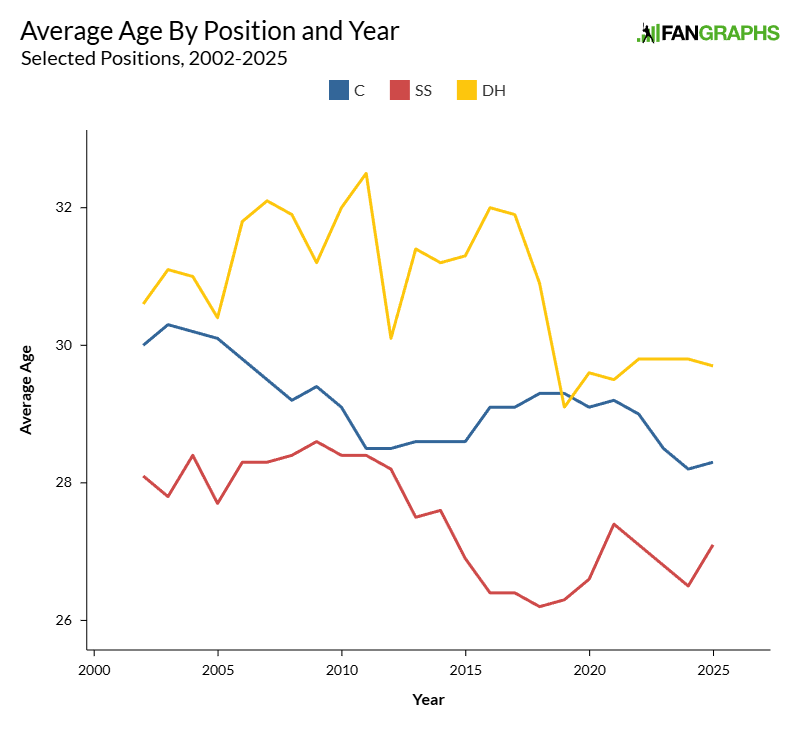
The info is fairly noisy, which is sensible to me. It’s not like groups are focusing on a given age; they’re simply making baseball selections about value, group management, and manufacturing. Common age is a downstream results of numerous selections which are made for different causes. However within the combination, the sample I hoped to see simply wasn’t there:
Common Age By Period, Place
| Interval | C | SS | DH |
|---|---|---|---|
| 2002-2010 | 29.7 | 28.0 | 31.4 |
| 2011-2020 | 28.9 | 27.1 | 31.0 |
| 2021-2025 | 28.7 | 26.7 | 29.7 |
| 2002-10 vs. 2021-25 | -1.1 | -1.3 | -1.6 |
Actually, DH has skilled the best decline in common age throughout all positions. That’s very a lot not what I anticipated. I do suppose that a few of that’s overstated. First base has had the smallest decline amongst positions, and I’d anticipate most of the displaced older hitters I discussed in my speculation to finish up there too. However should you common the age adjustments of first base and DH, they’re nearly precisely the league common for place gamers. Clearly, the info don’t assist my declare.
You Aren’t a FanGraphs Member
It appears such as you aren’t but a FanGraphs Member (or aren’t logged in). We aren’t mad, simply dissatisfied.
We get it. You need to learn this text. However earlier than we allow you to get again to it, we would prefer to level out a number of of the nice the explanation why you need to turn into a Member.
1. Advert Free viewing! We can’t bug you with this advert, or another.
2. Limitless articles! Non-Members solely get to learn 10 free articles a month. Members by no means get lower off.
3. Darkish mode and Traditional mode!
4. Customized participant web page dashboards! Select the participant playing cards you need, within the order you need them.
5. One-click information exports! Export our projections and leaderboards to your private tasks.
6. Take away the photographs on the house web page! (Actually, this does not sound so nice to us, however some individuals needed it, and we like to offer our Members what they need.)
7. Much more Steamer projections! Now we have handedness, percentile, and context impartial projections out there for Members solely.
8. Get FanGraphs Stroll-Off, a personalized 12 months finish evaluate! Discover out precisely the way you used FanGraphs this 12 months, and the way that compares to different Members. Do not be a sufferer of FOMO.
9. A weekly mailbag column, solely for Members.
10. Assist assist FanGraphs and our complete employees! Our Members present us with crucial assets to enhance the positioning and ship new options!
We hope you may take into account a Membership in the present day, for your self or as a present! And we notice this has been an awfully lengthy gross sales pitch, so we have additionally eliminated all the opposite advertisements on this article. We did not need to overdo it.
However wait! That’s simply place gamers. My preliminary principle was about DHs, however there’s one other group of older gamers I all the time consider after I broadly categorize the league into age cohorts: pitchers. I’ve been writing concerning the new team-building technique of drafting hitters and signing older pitchers in free company for my complete FanGraphs profession. If it’s not the Cubs and the Astros, it’s the O’s and the Jays, or the Yankees and the Cardinals, or any variety of groups you may consider that match this mannequin. Final 12 months, solely six groups (the Guardians, Dodgers, Phillies, Pirates, Padres, and Mariners) had a pitching group youthful than their place participant counterparts.
Right here’s a unique means of wanting on the evolution of participant age over time:
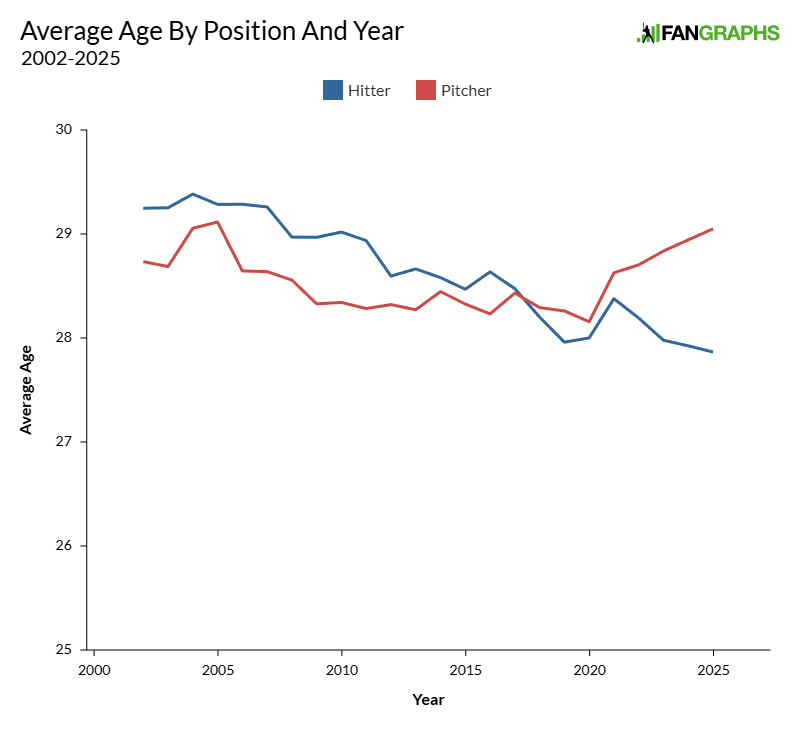
Oh. Yeah. That appears fairly important.
As I discussed, this isn’t some nice secret. Jeff Lamb wrote about all of it the way in which again in 2016 within the context of the cursebreaking Cubs. However at that time, the typical pitcher was nonetheless youthful than the typical hitter, they usually had been for many years. Since then, hitter age has continued to say no. Groups are doling out a file low share of plate appearances to batters 35 and older. Latest appears at growing old curves have proven hitters declining earlier and pitchers later. It matches the standard knowledge, as nicely: Hitters age, whereas pitchers break.
Many results have fed this divergence, however I feel that the strongest one is the evolution of groups’ opinions about pitcher workloads. Innings caps, workload administration, ramp-up plans: Groups are guarding their younger pitchers’ well being greater than ever earlier than, cognizant of the chance of damage that comes with overwork. In the meantime, pitcher growing old isn’t as extreme as hitter growing old, and the pitchers who’re most trusted to ship large workloads are those who’re already doing it. That results in extra groups looking for their pitchers from the group of at the moment performing veterans. It truly is the golden age of the older beginning pitcher. Pitchers debut simply as early as their hitting counterparts, however fashionable workload administration means groups lean on the olds anyway.
One other means of taking a look at it: Twenty-seven pitchers of their 30s threw 150 or extra innings in 2025. That’s fairly near the variety of 30-year-olds who threw 150 or extra innings in 2010 (30). The common from 2000 to 2015 was round 33 30-year-olds hitting 150 innings. That proportion of the sport hasn’t modified a lot in any respect. Then again, 2025 noticed 43 pitchers of their 20s hit that 150-inning threshold. Again in 2010, there have been 73 20-somethings who hit that mark. The common from 2000 to 2015 was roughly 62. In different phrases, we’ve seen an even bigger decline in workloads for youthful starters than older ones.
When group perceptions round well being restrict the workloads of younger pitchers disproportionately, you see the divergence in that chart. It’s not one thing anybody got down to do on function, no less than in my view. It’s only a pure consequence of the way in which groups function nowadays. The decline in hitter age is that, too: Good younger hitters with gobs of group management preserve knocking on the door earlier and earlier, and what are groups going to do, not play them? The damage threat appears utterly totally different there; older place gamers are extra in danger, not youthful ones, as finest as I can inform from the info. And thus, hitter age retains happening.
These are hardly the one causes that this conduct could possibly be occurring. Should you can consider a means that the sport has modified within the final 25 years, there’s an honest probability that it would, not directly, change relative pitcher and hitter age. Perhaps the common DH is getting extra younger fielders enjoying time. Perhaps the newest CBA has modified groups’ relative propensity to start out service time clocks on their younger hitters who may compete for awards. Perhaps, as Eric Longenhagen detailed in 2022, the Rule 5 draft pushes some worldwide pitching prospects to aid roles, getting them to the majors sooner however for smaller chunks of enjoying time. It’s a fancy drawback, and undoubtedly one with many right solutions.
It’s not fully correct to say that Main League Baseball is a younger man’s recreation nowadays. It’s true to some extent, little doubt. But it surely’s largely the case for hitters. Pitchers are headed in the wrong way. It’s a paradox Matthew McConaughey would recognize.