

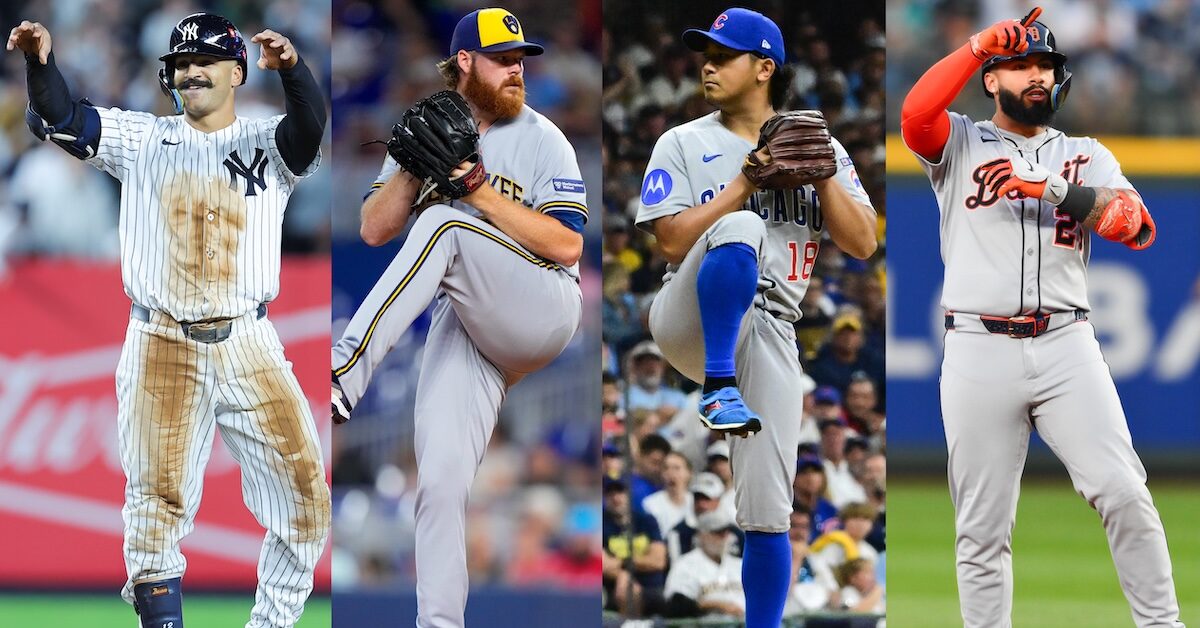
After Josh Naylor signed the primary main free agent deal of the offseason over the weekend, 4 extra huge names got here off the board Tuesday afternoon. Of the 13 free brokers who have been offered with qualifying affords, 4 accepted: Brandon Woodruff, Trent Grisham, Gleyber Torres, and Shota Imanaga will all return to their earlier groups on one-year contracts value $22.025 million.
Bo Bichette, Dylan Stop, Edwin Díaz, Framber Valdez, Kyle Schwarber, Kyle Tucker, Michael King, Ranger Suárez, and Zac Gallen all declined their qualifying affords and can hit the open market, carrying draft choose penalties to be decided by MLB’s inscrutable compensation system.
In case you’re pondering this can be a bumper crop of QO acceptance, you’d be proper. Within the first 14 years of the qualifying provide system, 144 affords have been prolonged to pending free brokers, and solely 14 accepted. This yr, practically one in 4 certified free brokers determined to financial institution the provide and stroll away, reasonably than face another multiple-choice query from Regis Philbin.
Having 4 gamers settle for the qualifying provide is unprecedented; the earlier report, three, was set in 2015 and by no means matched till now. On condition that we’re heading into the final yr of the collective bargaining settlement — and, by all indications, towards a lockout subsequent winter — there’s an apparent temptation to learn this as a bellwether for the labor market this winter, and for the tenor of subsequent yr’s negotiations.
Personally, I might be circumspect about drawing conclusions from the qualifying provide market. Taking the $22 million and alter that comes with a qualifying provide would possibly point out what these gamers (and/or their brokers) take into consideration the robustness of this winter’s free agent market, but when they have been so positive we have been headed for a 2004-05 NHL lockout-type occasion, I don’t know why they’d be taking the danger of a one-year deal.
I don’t need to low cost the bigger market forces completely, however the obvious clarification for these 4 gamers taking the qualifying provide is that every of them has motive to doubt whether or not a richer long-term deal is coming down the pipeline. I’ll take care of every briefly.
Woodruff is the obvious case. The Brewers’ longtime ace was already non-tendered after the 2023 season, when he blew out his shoulder. Woodruff re-signed on a two-year, $17.5 million take care of a $20 million mutual choice for 2026; this may enable him to finish the multi-year rehab course of on the membership’s dime, whereas giving Milwaukee first dibs on the previous Mississippi State star as soon as he returned to health.
Woodruff lastly bought again into the rotation in July, and he was dynamite. In 12 begins, he posted a 3.20 ERA, a 3.17 FIP, and profession bests in each strikeout fee and stroll fee. However he suffered a lat pressure in mid-September that price him an opportunity to play within the postseason (leaving Milwaukee with a rotation of Freddy Peralta, adopted by as many Aaron Ashby opener video games because it took for Peralta to recharge). Even earlier than that, Woodruff’s fastball was down two and a half ticks from the place it was in 2023, and three miles an hour from the place it was in 2022, his final absolutely wholesome season.
Woodruff turns 33 in February; he’s three years and two important accidents faraway from his most up-to-date 100-inning season. I doubt anybody was going to fork over the type of cash Woodruff may moderately command if he had a stronger observe report of well being. On the identical time, he’s already bought a $10 million choice buyout within the financial institution. Why not take one other $22 million to stick with the one group he’s ever recognized, which simply so occurred to have the most effective report within the Nationwide League final yr? If it really works out, he’ll return available on the market with a clear invoice of well being and no draft picks hooked up.
The opposite pitcher on the record, Imanaga, has needed to navigate a contractual labyrinth of his personal. I used to be surprised when the Cubs turned down Imanaga’s three-year, $57 million group choice just a few weeks in the past. The left-hander had had his share of points with the house run over his temporary MLB profession, particularly in 2025. However he by no means walks anybody, and wholesome left-handed arms aren’t precisely bobbing up from the very residing earth as of late. (Imanaga spent eight weeks on the IL with a hamstring difficulty, however I mentioned “arm” simply now for a motive.) The Cubs may’ve had that for 3 years at a $19 million AAV. Which feels like lots, however the Tigers — not the Dodgers or Mets, a group for which cash is actual — simply paid Alex Cobb $15 million to not pitch in any respect. The open market is treacherous, associates.
Imanaga then turned down his personal $15 million participant choice for 2026, at which level the Cubs tagged him with the qualifying provide. That additional lowered Imanaga’s free agent leverage whereas primarily growing the worth of his participant choice by half.
I actually was gobsmacked that the Cubs would threat letting beginning pitcher go like that, however now that the entire state of affairs has performed out, it looks as if the Cubs have shot the moon right here.
I like Imanaga. I feel the Cubs want him, and at $20 million or thereabouts, he’s a cut price. On the identical time, I perceive why they may have issues about committing to him for a number of years. By turning down the choice and qualifying Imanaga, they gave him extra up entrance — about $2 million extra this season in actual cash and about $3 million in opposition to the aggressive steadiness tax — however they keep away from committing to him by his age-34 season.
On the identical time, Imanaga’s posting charge contains an escalator clause, commonplace amongst offers like this, that obliges Chicago to pay 15% of all exercised choices and bonuses on high of the unique posting charge. (Because of the immensely discovered Jon Becker for his assist monitoring this down.) Let’s do the mathematics actual fast: 15% of $57 million is $8.55 million. Even when the QO counted towards the posting charge, which I don’t suppose it does, the Cubs would save about $5.25 million in posting charges.
So Imanaga will get more cash up entrance — much more than he’d be entitled to beneath his participant choice — and if he was ticked off about dropping the 2 group choice years, he’s not too ticked off to take the qualifying provide. The Yokohama DeNA BayStars are positively getting screwed, however what are they going to do about it?
And the one method the Cubs come out of this wanting silly is that if Imanaga goes out and has a monster 2026 season. Like, contends for the Cy Younger Award and walks into $35 million a yr on his subsequent deal when the Cubs may’ve had him for $19 million. And even then, I really feel just like the Cubs could be OK with that, as a result of a world during which Imanaga pitches that nicely might be one during which the Cubs win plenty of video games.
As for the place gamers, I wrote up Grisham for our Prime 50 Free Brokers record, and wasn’t positive what to make of him. As a result of he was actually good for the Yankees in 2025, and he achieved this by being a totally completely different participant than he was early in his profession. A speed-and-defense man for years, Grisham hit 34 dwelling runs and was barely satisfactory in heart.
All of our contract predictions for Grisham got here in someplace round three years and $54 million, which is the neighborhood of contract the place the QO makes a distinction. You’re already outbidding the marketplace for a man with some severe questions; do you need to lose two excessive draft picks and $1 million in worldwide bonus pool cash too?
Discretion might be the higher a part of valor right here for Grisham. He can proceed to play for a profitable group, in a park that might not be a greater match for his swing, and rating 1,000,000 runs hitting in entrance of Aaron Decide. And as one of many youthful gamers on this free agent class, Grisham can afford to take a do-over. If he does all this once more subsequent yr, he’ll make that $18 million AAV seem like peanuts, particularly if the Gold Glove-quality heart discipline protection comes again. If not, nicely, there was severe draw back risk for a participant like this in what is perhaps a bear market.
Torres has lots in widespread with Grisham; he had yr in close-to-ideal circumstances, however whereas his offensive expertise are intensive, the general profile doesn’t play as nicely in a nook outfield spot as it will up the center. And with each one-year deal Torres takes — keep in mind, he bought skunked in 2024-25 and settled for a $15 million prove-it take care of the Tigers — the day of defensive reckoning comes nearer.
I feel there’s much less upside to Torres taking the qualifying provide than the opposite three — I don’t see him placing collectively a 2026 season that’d herald a nine-figure contract until one thing actually wild occurs — however he hit the market with no strings hooked up final season and didn’t do that nicely.
So whereas it’s uncommon for anybody to simply accept a qualifying provide, and unprecedented for 4 gamers to do it on the identical day, I get it. Each one among them has a motive to take $22 million now, reasonably than threat it on the open market, particularly given the upcoming labor uncertainty. And double-especially, contemplating that every of them had been saddled with the millstone of draft choose and worldwide bonus pool compensation.
Greater than that, I feel it’s a product of groups being a bit looser with the QO. It’s not only a formality for stars, it’s a respectable market-rate provide for gamers who’re both merely above common or have a historical past of harm. In case you’re going to signal a one-year prove-it deal anyway, why waste the entire offseason ready for it to come back?