

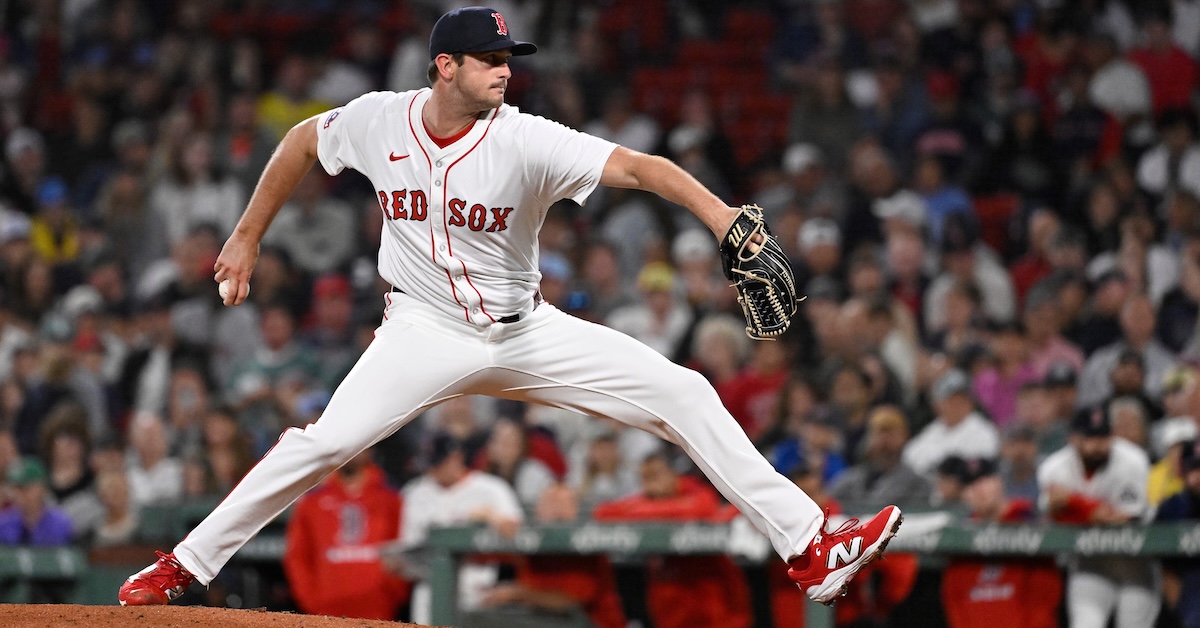
4 years in the past, Garrett Whitlock’s emergence as an elite main league reliever was considered one of my favourite tales in baseball. How may it not be? He was a Purple Sox Rule 5 choose who had been on the Yankees. It doesn’t get a lot better than that. He was a dominant multi-inning reliever proper from the soar, with a 1.96 ERA over 73 1/3 innings pitched and glorious peripheral statistics throughout the board.
The years since then haven’t been so halcyon. He adopted up his breakout with one other good 12 months of relieving, however a foray into beginning went solely OK. Whitlock began 2023 season within the rotation however pitched poorly, hit the IL thrice, and ended the 12 months as a mid-leverage bullpen arm. Then he tried the rotation once more in 2024, however harm his elbow after 4 begins and had inner brace surgical procedure. All advised, these three seasons got here with a 4.01 ERA, a 3.71 FIP, and never a ton of quantity.
That inner brace surgical procedure brings us to this 12 months. Inner brace procedures include quicker turnaround occasions than full Tommy John surgical procedure, and Whitlock was prepared for Opening Day. He began the season as a center reliever and mopup man, getting into within the fifth, fourth, and eighth (down 4 runs) for 2 innings apiece in his first three appearances. He didn’t look instantly restored, however who would? After he acclimated to the majors once more, although, his command snapped again to its prior very good degree, his secondaries improved, and he’s been nothing in need of excellent. Welcome to Garrett Whitlock’s second act.
Whitlock used a traditional three-pitch combine in his breakout season: sinker, slider, changeup. The key ingredient, although, was command. His fastball has dead-zone form, and he doesn’t throw with overwhelming velocity, however he makes up for that by recognizing it nicely. Entrance-door sinkers, 2-1 choices that begin over the plate and find yourself on the arms, dotted corners in two-strike counts; you identify it, Whitlock can use his fastball to do it.
That three-pitch combine goes in addition to ever. The one actual change he’s made is throwing extra sliders. Extra importantly, he’s regained his really feel for command, and the outcomes have been arrow up ever since. Because the calendar turned to June, Whitlock has pitched 23 innings, greater than some other Sox reliever. He has a 1.96 ERA and a 1.41 FIP. He’s putting out greater than a 3rd of the batters he faces. He’s been among the finest relievers in baseball, full cease.
How is he doing it? Properly, if the reply had been simply “the identical means,” this wouldn’t be a really attention-grabbing article, so let’s dive into the particulars some extra. It begins along with his fastball. I’ve known as it a sinker a number of occasions now, and Statcast agrees, however that’s extra technicality than the rest. He throws it with a two-seam grip, which is why it will get that classification, nevertheless it rises as a lot because it tails and doesn’t get grounders at an elevated price; he even throws it excessive within the zone greater than he does low. Don’t get too tied up on the nomenclature; the important thing level is that it’s a fastball with uncommon traits, so it doesn’t match any of the standard sinker/four-seamer/cutter labels we use to categorise heaters.
Primarily based on how I described it, his fastball positive feels like it might be a hittable pitch. To get a way of how hittable, I checked out the way it performs when thrown over the center of the plate — essentially the most crushable location. And when opponents make contact with it over the center of the plate, they’re batting .390 and slugging .580, each meaningfully north of the massive league common for sinkers. However that’s one of many issues of evaluating Whitlock’s pitch to a sinker. As I’ve already talked about, it doesn’t share many traits with the typical sinker.
For instance, sinkers nearly by no means draw swings and misses. On these aforementioned sinkers over the center of the plate, hitters come up empty on about 9% of their swings. Towards Whitlock’s fastball, hitters miss on 18.4% of choices. That’s four-seamer territory, no matter what you name it. And when Whitlock throws his fastball over the center of the plate, he’s permitting a .403 wOBA, in comparison with the .408 mark for a median four-seamer to that location. So along with getting extra whiffs than the typical sinker when thrown to this most hittable location, his fastball can also be permitting about the identical harm on arduous contact as the typical four-seamer.
Perhaps we aren’t nice at calling it by the fitting identify, or perhaps fastball classification is only a hopelessly tough endeavor. Regardless, Whitlock will get to an average-ish fastball in a bizarre means, and with that acceptable pitch, he floods the strike zone. First pitch of an at-bat? He makes use of his fastball 60% of the time, and he throws them for strikes 60% of the time. Behind within the depend? He throws his fastball much more and lives within the strike zone 66% of the time.
With these big zone charges – all means above league common – Whitlock will get right into a ton of favorable counts. Greater than a 3rd of the pitches he throws include him forward within the depend. There aren’t numerous dangerous pitchers within the prime 10 for that statistic:
P.c of Pitches Thrown Forward in Rely, 2025
As soon as he’s forward, Whitlock typically goes to his slider for the knockout. It’s a troublesome pitch to categorize, similar to his fastball. It’s unremarkable when it comes to form and velocity, nevertheless it pairs nicely along with his heater, and he can successfully transfer it across the zone or spot it low and away to right-handers. He sweeps it typically, too, taking a number of miles an hour off and getting extra horizontal motion. Once more, it’s not a nice sweeper when it comes to uncooked motion, however the number of appears provides up and retains opponents off-balance.
his sliders offers an awesome window into how he does it. For the sake of our evaluation, we’re going to lump collectively his conventional slider and sweeper, as his sweeper acts like a variation of his slider greater than a definite pitch, and consult with each merely as his slider. Each of our pitch fashions agree that his slider is roughly common stuff-wise. Each of our pitch fashions additionally agree that it’s roughly common location-wise; the sharp command he demonstrates is generally along with his fastball and changeup. As an alternative of common outcomes, although, he’s making batters look silly along with his slider. They chase sliders outdoors the strike zone almost 40% of the time, roughly indistinguishable from the chase price that Chris Sale and Jacob deGrom get on their far-more-famous sliders. In the meantime, batters swing at lower than 60% of the in-zone sliders he throws (league common is 67%). They will’t determine what to do and might’t acknowledge the slider in time, so that they find yourself guessing, primarily.
Due to all these dangerous swings and dangerous takes, Whitlock’s slider does one thing that’s arduous to wrap your head round. When he throws it within the zone, he misses bats at a median price. When he throws it out of the zone, he misses bats at a median price. Regardless of these two issues, his slider misses bats at an above-average price general. How is that attainable? It’s as a result of an enormous proportion of opposing swings come outdoors the strike zone, the place batters swing and miss way more incessantly.
My favourite a part of Whitlock’s breaking ball is his means to control its motion. Check out the typical motion on the pitch, and also you’ll get an concept of how he’s modified it over time:
Slider Traits by Yr
| Yr | Velo (mph) | Horizontal (in.) | Induced Vertical (in.) |
|---|---|---|---|
| 2021 | 83.7 | 4.4 | 0.4 |
| 2022 | 83.2 | 1.6 | -1.4 |
| 2023 | 79.6 | 9.3 | -4.0 |
| 2024 | 82.4 | 7.8 | -3.3 |
| 2025 | 84.3 | 4.5 | -6.0 |
However much more than that, he modifies it inside video games, inside at-bats. Have a look at the large dispersion in sweeper and slider motion, as proven by Baseball Savant:
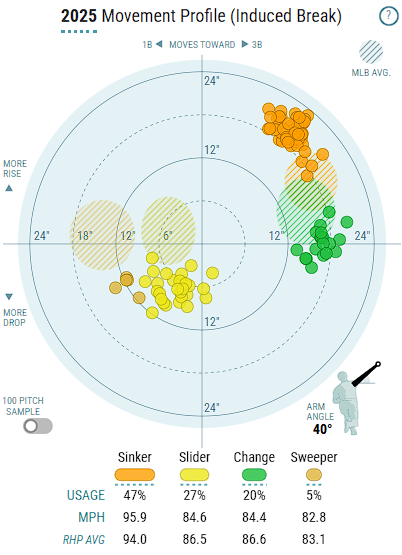
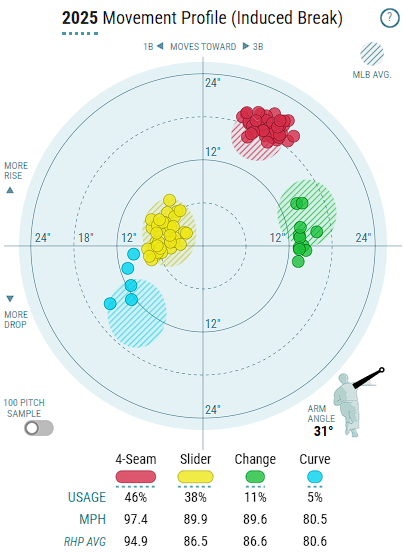
Evaluate that to deGrom, one other great-command slider thrower, and you may simply see how rather more selection Whitlock employs. Virtually all of deGrom’s sliders (proven under) transfer the identical. Whitlock’s (above) are all around the map:
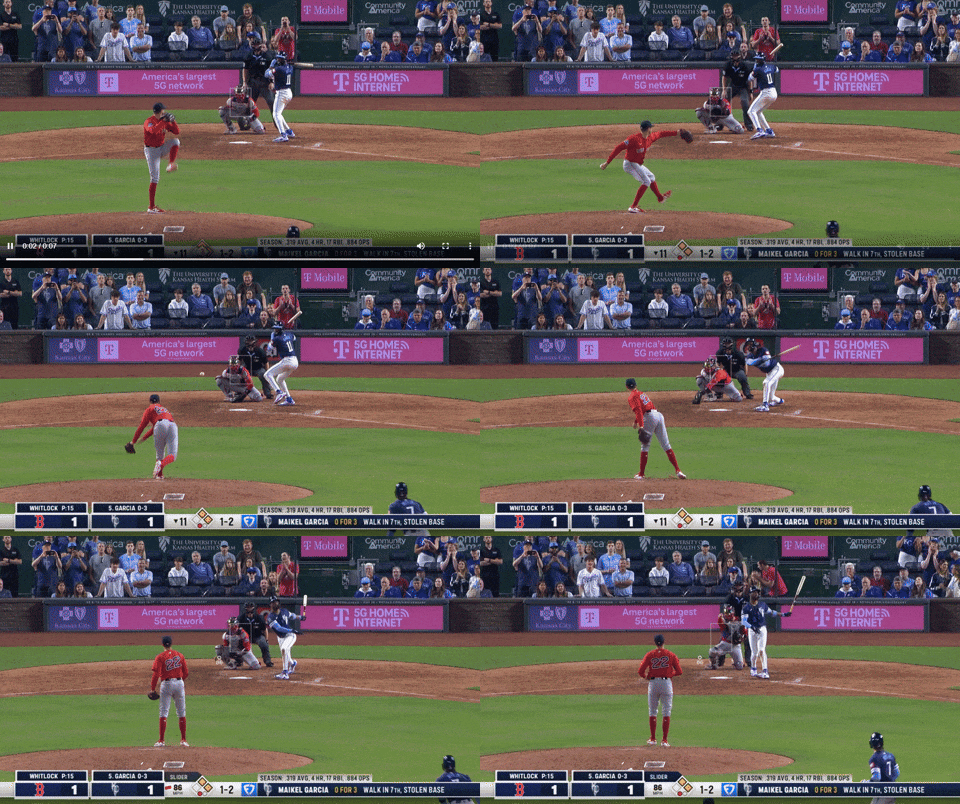
In apply, which means hitters have much more space to cowl. Provided that Whitlock’s slider has by no means been a standout for producing swings and misses in any form, I like his adaptation to confuse swing selections by throwing a ton of various sliders. Right here’s an instance from Could. In an 0-1 depend, Whitlock took somewhat off his slider and tilted it downwards (zero inches of horizontal break, damaging six inches of induced vertical break):
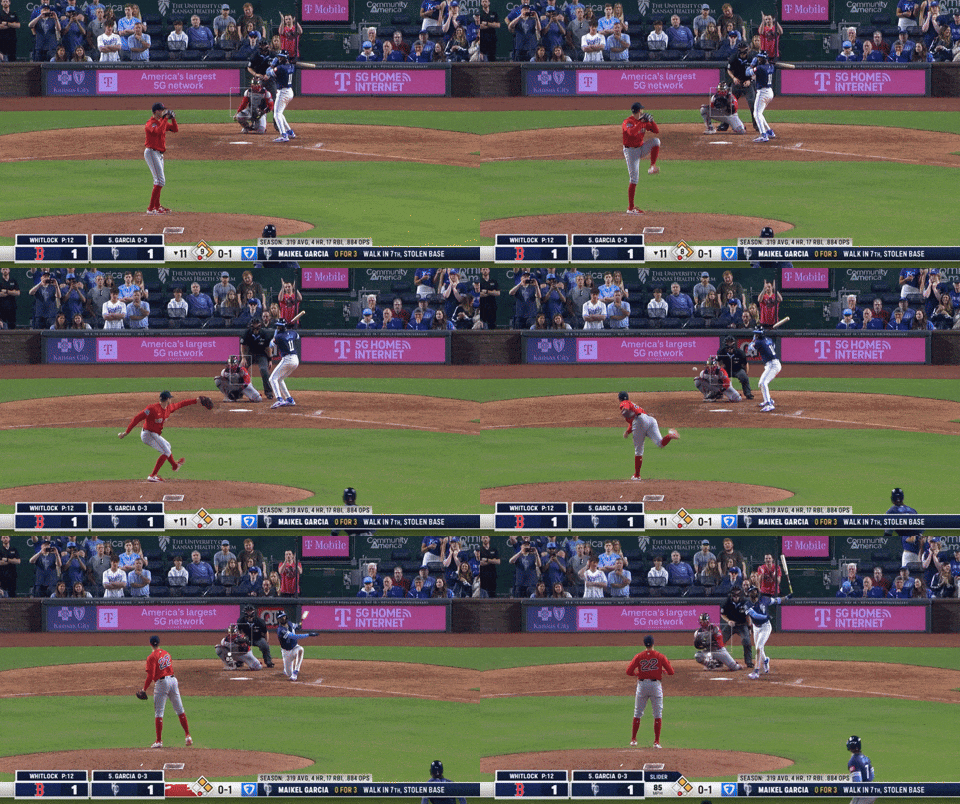
Then he got here again two pitches later and threw one other slider towards the identical spot. The one distinction? This one had seven inches of glove-side motion, sufficient to curve outdoors the zone and depart Maikel Garcia wanting foolish:
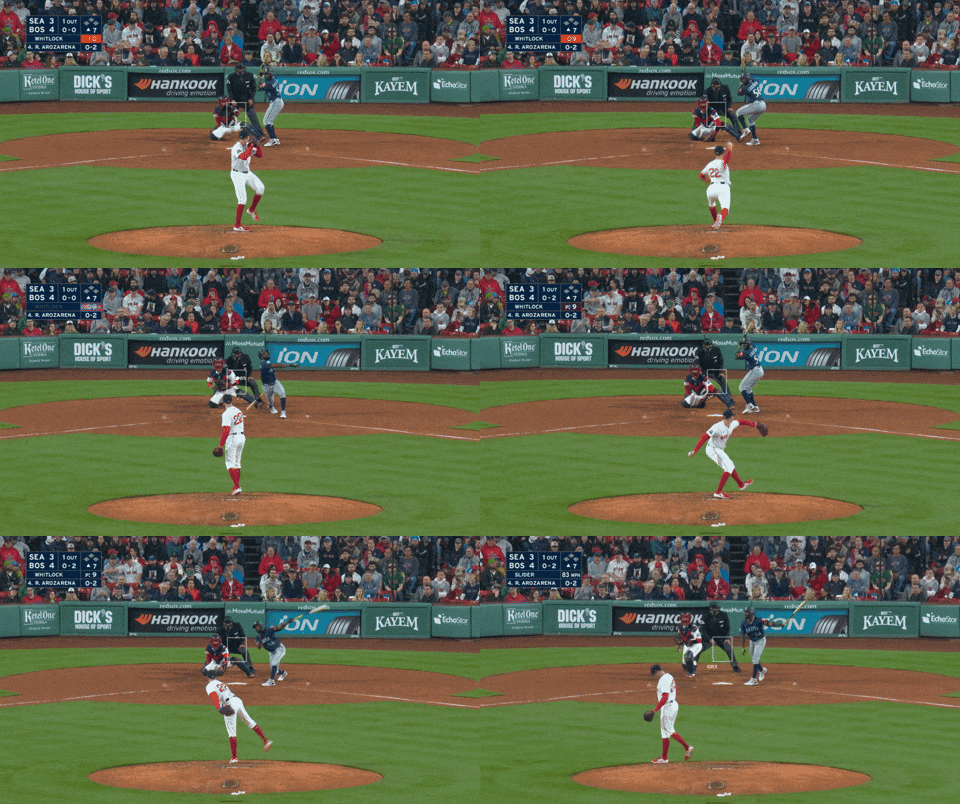
One other instance? Certain. First, Randy Arozarena took a mighty hack at a gyro slider, just one inch of glove-side motion at 85 mph. Then Whitlock took somewhat off, buying and selling two mph for 5 inches of glove-side break and an additional three inches of induced downward break. The outcome? Arozarena misjudged the place the pitch was going to be:
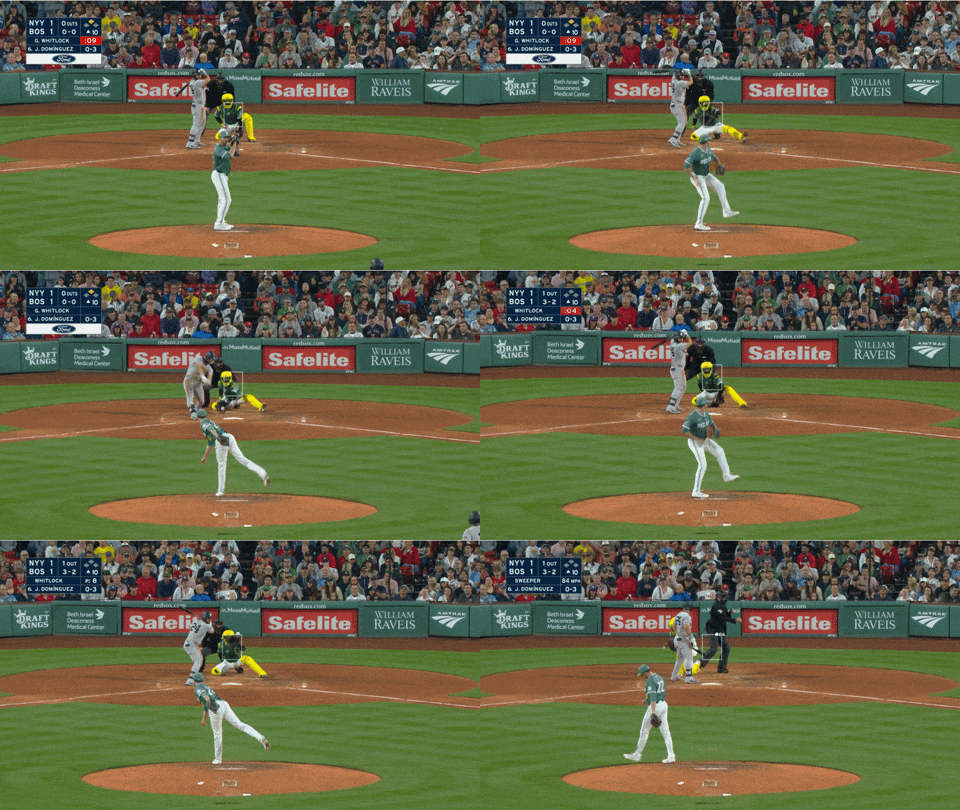
Right here’s an exceptionally nasty mixture. Whitlock started with a diving slider with pure north-south motion — zero horizontal break, simply damaging 9 inches of induced vertical break. Then, in a 3-2 depend, he threw a a lot bendier one, with eight inches of glove-side break, to clip the nook and catch Jasson Domínguez wanting:
I picked these examples fastidiously, after all. Whitlock isn’t various his slider motion by six-plus inches in opposition to each batter he faces, and typically the variations don’t work out in his favor. However it’s absolutely an asset to have a lot uncertainty round your slider that hitters can’t go up there with a good suggestion of what form it can take. It’s much more harmful to take an in depth pitch should you can’t inform whether or not it’s going to curve by three inches or 9.
That uncertainty works rather a lot higher once you’re forward within the depend, however as we’ve already lined, that’s Whitlock’s biggest power. He will get forward along with his fastball and closes issues out with quite a lot of sliders. Until we’re speaking about lefties – in opposition to them, he throws a changeup 30% of the time (11% in opposition to righties) to introduce a full three-pitch combine. That simply makes their job more durable; his changeup appears like a fastball out of hand earlier than tumbling and fading. He throws it on the identical velocity as his slider, nevertheless it falls six inches much less and breaks about 20 inches the opposite means horizontally.
Truthfully, I don’t want a lot convincing that Whitlock is nice. He has a profession 2.72 ERA as a reliever in almost 200 innings of labor, with a 2.85 FIP to match. (He’s at 4.29 and three.97, respectively, as a starter.) However it’s a superb reminder that the Sox have one other aid ace regardless of largely sitting out the reliever market on the commerce deadline. He’s again towards the highest of the bullpen hierarchy, getting high-leverage assignments left and proper. He’s among the finest relievers in baseball – similar to earlier than.