
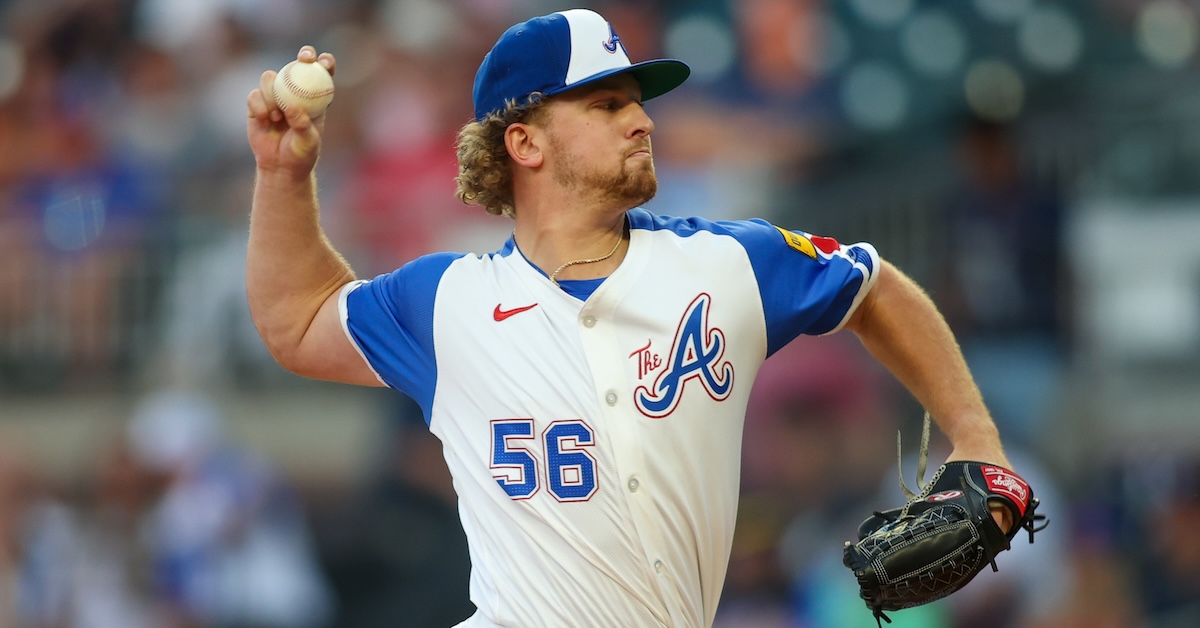

I’m not a lot of a YouTube man or, actually, a fan of movies normally. For those who ship me an Instagram reel, I’m sorry, I cannot watch it. However Lance Brozdowski delivers his baseball ideas in video kind, so I’m compelled to make an exception. Lance’s posts prodded me to begin writing about baseball within the first place; I all the time study one thing after I watch his stuff and have a tendency to agree with all of his evaluation.
So I used to be shocked — shocked! — to listen to him specific pessimism about Spencer Schwellenbach in a latest video. All via this offseason, I’ve had the alternative thought: There isn’t sufficient enthusiasm about Schwellenbach’s rookie marketing campaign, throughout which he posted a 3.29 FIP over 123.2 innings. However Lance wasn’t the one one with a tepid appreciation for the right-hander. Eno Sarris ranked him as his Thirty fourth-best beginning pitcher; Thomas Nestico had him at no. 36. If I have been obliged to make such a listing, I is likely to be pushing him some 20 spots increased. I feel Schwellenbach’s rookie excellence could be repeated and even improved upon for one key purpose: When he delivers the baseball, no one is aware of what to anticipate.
Take into account Schwellenbach’s scores in relation to Baseball Prospectus’ new arsenal metrics. These metrics analyze a given pitcher’s arsenal and grade it throughout 4 classes: Pitch Sort Chance, Shock Issue, Motion Unfold, and Velocity Unfold. As I wrote in January, “Every rating is transformed right into a percentile kind, permitting for simple comparisons between pitchers. The knuckleballer Matt Waldron, for instance, ranks as a 98 in Shock Issue, the best amongst all pitchers.” It’s these first two qualities — Pitch Sort Chance and Shock Issue — the place Schwellenbach stands out amongst his friends. In opposition to hitters from each side of the plate, Schwellenbach makes use of his huge combine and the overlapping motion between his pitches to domesticate confusion. As Michael Baumann wrote about Schwellenbach final September, “He can throw something, anyplace, at any time.” Check out his arsenal scores:
Spencer Schwellenbach Arsenal Scores
| Batter Handedness | Pitch Sort Chance | Shock Issue | Motion Unfold | Velocity Unfold |
|---|---|---|---|---|
| Proper-handed | 98 | 89 | 82 | 75 |
| Left-handed | 96 | 94 | 84 | 77 |
SOURCE: Baseball Prospectus
Percentile rankings, 2024 season.
Schwellenbach even stays unpredictable on the rely degree. There isn’t a single rely — to righties or lefties — the place Schwellenbach threw a pitch in even 50% of conditions. His most predictable pitch/rely mixture was his slider to right-handed hitters in 1-2 counts; in 105 of those conditions, he opted for that pitch 50 instances, or 47.6% of the time. For comparability, Logan Gilbert — who additionally has six pitches and throws his four-seamer a just about an identical quantity of the time — had seven totally different pitch sort/rely combos above 50% utilization. (In 1-0 counts to lefties, for instance, Gilbert threw his slider almost 60% of the time.)
Schwellenbach’s 0-0 tendencies illuminate the issue of sitting on one particular pitch in opposition to him. To lefties in 0-0 counts, he threw his curveball 35% of the time and his four-seamer 33% of the time; there was roughly a one-in-three probability you’d see certainly one of his different 4 pitches. To righties on the primary pitch of a plate look, the curveball dropped all the way down to 11.4% utilization; the fastball was thrown 38% of the time, the cutter 23.6%, the slider 19.2%.
However he isn’t only a artful deep-mix man — the stuff is nasty. Schwellenbach throws three fastballs, together with a four-seamer that averaged 96.1 mph in 2024, rating within the ninetieth percentile of all starters final season. The form on that four-seamer, nonetheless, is so-so — his low arm angle and tendency to chop the baseball means it doesn’t get a lot of that bat-missing vertical hop:

It’s actually the offspeed stuff that units him aside. In opposition to right-handers, Schwellenbach wields a grimy slider, thrown with plus velo and sharp two-plane break. For lefties, there are two choices to induce swing-and-miss: a splitter, dropping over a foot under his common four-seam fastball, and a low-80s curve, tunneling proper beneath his tougher slider.
Impressively for a rookie who transformed to pitching full-time simply three seasons in the past, he manages to throw all six of his pitches for strikes. The situation plots recommend that Schwellenbach is a control-over-command sort of pitcher at this stage of his profession, preferring to problem hitters over the plate slightly than goal for nice targets. Take into account the areas of his four-seam fastballs in opposition to right-handed hitters. Maybe there’s a slight tendency to focus on the surface a part of the plate, however that’s quite a lot of fastballs over the guts of the strike zone:

That type of aggression could be accommodated when hitters have such a dim thought of which pitch is coming subsequent, to not point out so little time to react to it. And it actually saved the walks down: His 4.6% stroll price was eighth amongst all pitchers with no less than 100 innings pitched final yr.
Greater than any particular part of his recreation, Schwellenbach’s excellence could be greatest defined by the way it all suits collectively. Solely a handful of beginning pitchers handle to area their pitches aside whereas concurrently making them look related out of the hand. Usually, it’s two forms of guys. There are the Patrick Corbins and Miles Mikolases of the world, overcoming subpar velocity with deception and guile. After which there are the pitchers who handle to mix these traits with top-tier velocity.
Utilizing an analogous methodology to Baseball Prospectus, Driveline’s Combine+ and Match+ fashions measure the motion unfold of a given pitcher’s arsenal and the similarity of the motion out of the hand, respectively. There have been three pitchers who posted no less than a 105 Combine+, a 105 Match+, and averaged no less than 96 mph on their four-seam fastball: Paul Skenes, Tarik Skubal, and Schwellenbach. (Within the pursuits of not choosing arbitrary endpoints to make my level stronger, I’ll concede that Cole Ragans and Nathan Eovaldi missed the fastball velocity cutoff by 0.6 mph.)
Schwellenbach’s pitch plot reveals how he accomplishes this feat. In contrast to almost another pitcher in baseball, his pitches contact all 4 quadrants of the plot, concurrently protecting a ton of area whereas creating bridges between every pitch:

It’s value contemplating Lance’s doubts intimately. As he factors out, Schwellenbach wasn’t nearly as good in opposition to left-handed hitters. His strikeout price vs. lefties — 21.8% — was roughly league-average. And the flip facet of Schwellenbach’s huge arsenal is that there isn’t essentially a brand new trick to unlock that can remedy this drawback. Pitchers like George Kirby, Gilbert, and Bryce Miller ascended to new ranges by including pitches to their repertoire and subsequently slicing their heavy use of their four-seam fastball. Schwellenbach is already close to the underside of all beginning pitchers in major fastball utilization; presumably, it could actually’t go a lot decrease than 30%. If he’s “maxed out,” as Lance places it, which means he won’t have a trick up his sleeve in opposition to opposite-handed hitters.
However I’ve a way that Schwellenbach may have the ability to assuage Lance’s doubts with a simple tweak: growing his early-count cutter utilization.
Schwellenbach most well-liked to throw his cutter to right-handed hitters, focusing on the surface of the plate the place it tunneled properly together with his four-seam fastball. That was on show in his ultimate begin of the season, a seven-inning gem in that wild first recreation of the September 30 Braves-Mets doubleheader, at first went nuts. He threw zero cutters via the primary 4 innings; it completed as his most-used pitch that day. He threw 24 cutters to righties, utilizing it as his major fastball the second and third time via the order; he threw simply two to lefties.
Within the common season, the cutter was his fourth-most used pitch in opposition to left-handed hitters; he threw the four-seamer with double the frequency. Lefties did the majority of their harm off that four-seamer. If he reached two strikes, he was in a great spot — lefties whiffed 45.8% of the time they swung at his splitter. However to deploy that chase pitch, Schwellenbach first has to get to 2 strikes. Final season, he largely used the cutter when he fell behind lefties, attempting to induce weak contact when his again was in opposition to the wall. (It was his most-used pitch in opposition to lefties in 2-0, 2-1, and 3-1 counts.) Schwellenbach may select to extend the utilization of the pitch in early counts, stopping opposite-handed hitters from searching four-seamers earlier than the arrival of the dreaded two-strike splitter.
The fastball form is much from perfect; Schwellenbach nonetheless has some issues to determine in opposition to lefties. However I simply don’t see some large correction occurring. He instructions a large combine, wields weapons to each lefties and righties, throws his heater with plus velo, and even fields his place with the perfect within the enterprise (his +5 DRS was tenth amongst all pitchers). And if a pitcher refuses to be predictable, how are hitters supposed to regulate?